German to English Translation Errors That Can Cost You Time and Money
By Notarised Translations UK 16-06-2026 314
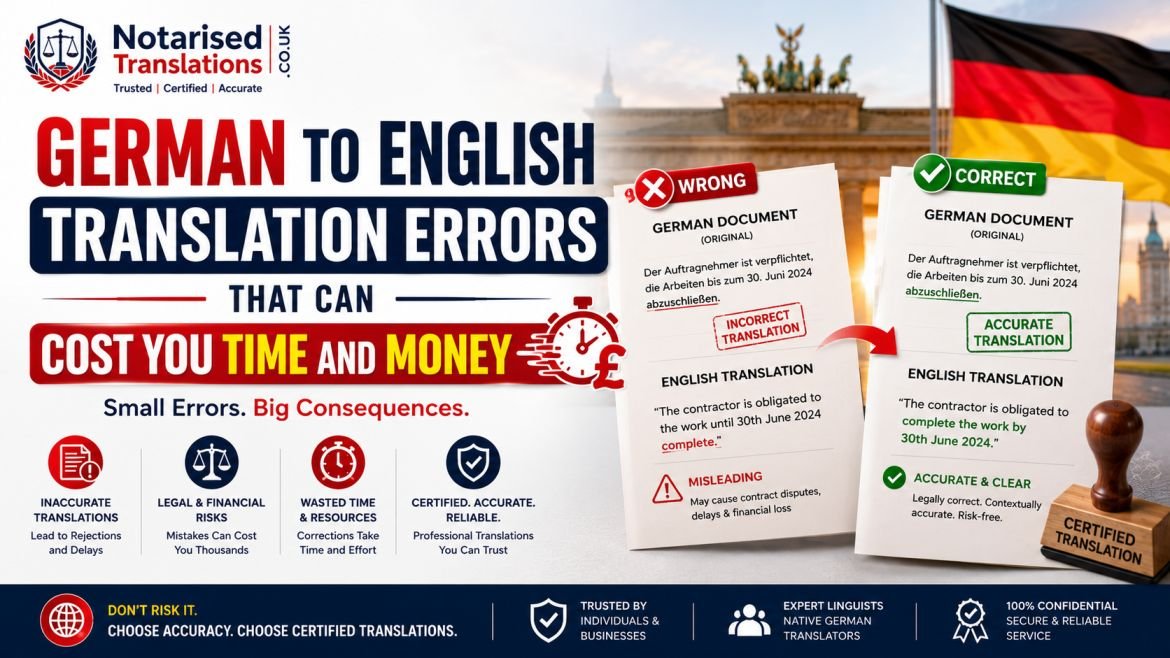
Most translation mistakes don't look dangerous when they happen.
That's the tricky part.
Nobody opens a translated document and immediately thinks, "This small wording issue is going to delay my visa application, complicate my legal matter, or force me to resubmit paperwork three weeks from now."
Yet I've seen exactly that happen.
A date translated incorrectly. A legal term simplified too much. A missing note near the bottom of a document that seemed completely insignificant at the time.
Then the authority reviewing the paperwork spots the issue.
And suddenly what should have been straightforward becomes complicated.
When it comes to German to English translation, small errors have a habit of creating surprisingly expensive consequences.
The Mistake That Looks Harmless
German documents often contain terminology that doesn't translate neatly into English.
At first glance, it can seem tempting to choose the closest equivalent and move on.
Sometimes that works.
Sometimes it doesn't.
A legal document, for example, may contain administrative terms, court references, or official designations that have no direct English counterpart. Translating them too loosely can alter the meaning of the document without anyone realising it immediately.
I've seen situations where a translation was technically readable but still unsuitable for official use because important legal distinctions had disappeared during the process.
The words were there.
The meaning wasn't.
Dates, Names and Numbers Cause More Problems Than You'd Expect
Oddly enough, some of the most common translation issues have nothing to do with language.
They're administrative.
Dates.
Reference numbers.
Addresses.
Personal details.
A single incorrect digit can trigger questions from an authority reviewing the document.
And once questions start, delays often follow.
This becomes especially important for immigration translation projects where consistency across multiple supporting documents is essential.
If one translated document contains information that differs from another, even accidentally, authorities may request clarification before continuing the process.
That can mean additional costs, additional paperwork, and additional waiting.
None of which are particularly enjoyable.
Legal Documents Leave Very Little Room for Error
Legal paperwork is one of the areas where accuracy matters most.
Perhaps that's obvious.
Still, people underestimate it.
A contract, court judgment, power of attorney, or official certificate may contain language carrying specific legal consequences. Translating those terms incorrectly can create confusion regarding rights, responsibilities, or legal status.
That's why professional legal translation requires more than language fluency.
It requires understanding.
Context.
Experience.
And occasionally a healthy respect for how much damage one incorrect phrase can cause.
Official Acceptance Depends on More Than Good Grammar
This catches many people by surprise.
A translation can be grammatically flawless and still fail to meet official requirements.
Authorities are usually interested in accuracy, completeness, and document reliability rather than elegant writing.
For example, an embassy accepted translation often needs to reflect every relevant detail of the original document, including stamps, annotations, signatures, and official markings.
Leaving out seemingly minor elements can create questions later.
And questions are rarely what applicants want when deadlines are involved.
Why Machine Translation Still Creates Problems
Technology has improved dramatically.
There's no denying that.
But official document translation remains one of those areas where automated tools often struggle.
German administrative language can be remarkably precise. Legal documents can contain phrases that require contextual understanding rather than literal conversion.
I've reviewed machine-generated translations that looked convincing until someone familiar with the document type examined them closely.
Then the issues appeared.
Not obvious issues.
Subtle ones.
Which, in many ways, are the most dangerous.
The Difference Between Translation and Certified Translation
People sometimes assume all translations are treated equally.
In practice, that's rarely the case.
Authorities frequently require an official German translation prepared according to specific standards. In some situations, a sworn German translation may be requested depending on the receiving country's requirements.
Similarly, while many people search for English to German translation services or German to English translation support, the actual submission requirements often extend beyond language alone.
Certification.
Verification.
Acceptance standards.
These factors can be just as important as the translation itself.
Choosing the Right Provider Can Save More Than Money
It's easy to focus on translation costs.
Everyone does.
What people often overlook is the cost of correcting mistakes later.
Resubmitting documents.
Missing application deadlines.
Paying for new translations.
Waiting for additional reviews.
Those costs add up surprisingly quickly.
This is one reason many individuals and businesses choose Notarised Translations UK when dealing with important official documents. The goal isn't simply obtaining a translation.
The goal is obtaining one that can actually be used without complications.
That's a different objective entirely.
Final Thoughts
Most translation problems don't begin with major errors.
They begin with small ones.
A misunderstood legal term. An incorrect date. A missing note. A document prepared without considering official requirements.
When dealing with German to English translation, accuracy isn't just about language. It's about ensuring documents are suitable for legal matters, immigration translation, official applications, and embassy accepted translation requirements.
Because in the end, the most expensive translation mistake is rarely the translation itself.
It's the delay, stress, and extra work that follows after the mistake has already been made.