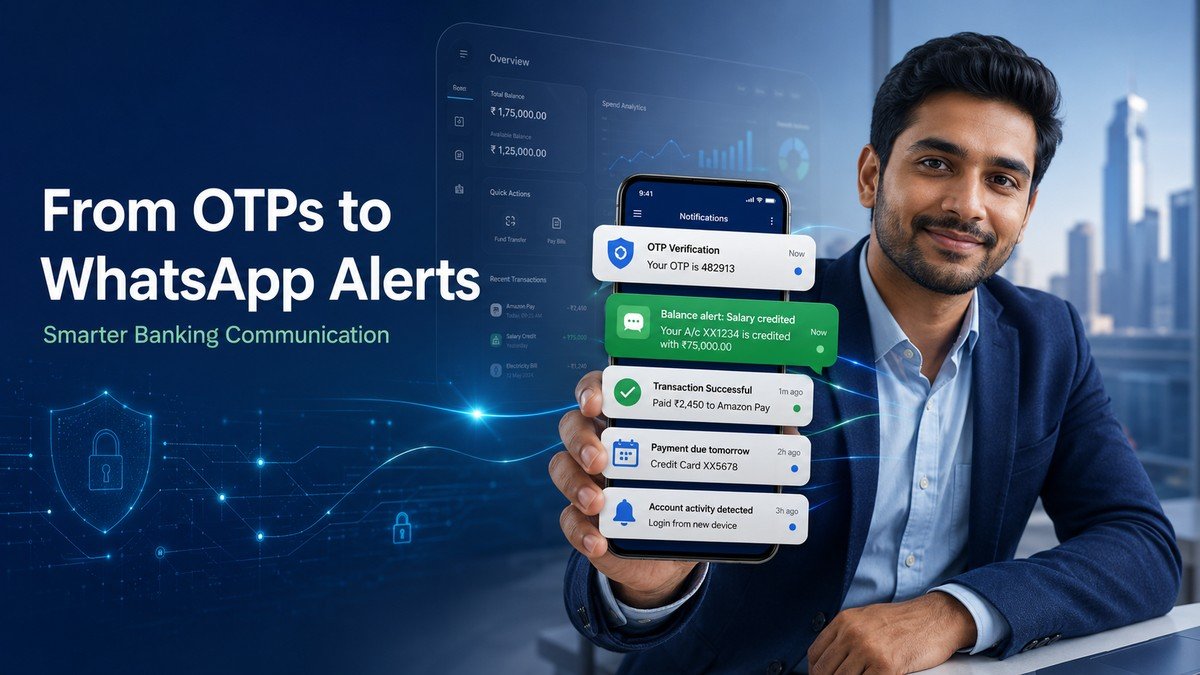
From OTPs to WhatsApp Alerts: How Banks Are Finally Getting Messaging Right
By Ranjan Dhibar 18-06-2026 170
Quick question - when's the last time you actually read a text from your bank, instead of just scanning it for an OTP and deleting it?
If you're drawing a blank, you're not alone. Bank texts have had a reputation for being dry, late, or plain ignorable. For years that was just the norm. That's slowly changing, and honestly, it's about time.
Why banking messages are harder than they look
Most brands can experiment freely with how they talk to customers. Banks and NBFCs don't get that luxury. Every message - an OTP, a payment confirmation, a loan reminder - has to be accurate, on time, and compliant with consent and data privacy rules. There's no room for a message landing five minutes late or reaching the wrong number.
That's exactly why a solid banking & financial messaging solution has stopped being a "nice to have." It's quietly become the backbone of how financial institutions keep customers informed without losing their trust or running into regulatory headaches.
Where a transactional messaging API actually earns its keep
This is the part that works behind the scenes. Unlike promotional texts, transactional messages are time-sensitive - OTPs, fraud alerts, EMI reminders, balance updates — and need near-instant delivery, no exceptions. A good transactional messaging API handles the heavy lifting: routing through the right channel, retrying failed deliveries automatically, and logging everything for audits.
For a bank, this isn't a convenience feature. It's the difference between a customer completing a payment smoothly and one stuck refreshing their screen, waiting for a code stuck somewhere in transit.
Why WhatsApp is becoming the BFSI go-to
Here's where it gets interesting. SMS still works, but it's limited - no formatting, no attachments, no real back-and-forth. That's a big reason banks and insurers are adopting WhatsApp Business API for BFSI communication.
Think about it from the customer's side. They're already checking WhatsApp a dozen times a day. So instead of digging through an SMS inbox for a statement, it just shows up as a document in a chat they already check constantly, with room to ask a quick question and get a near-instant reply.
For financial brands, that means fewer missed messages and actual two-way engagement — something this industry hasn't always been great at.
Tying it together with an omnichannel approach
The smartest setups don't lean on a single channel and hope it works. They run on an omnichannel communication platform that connects SMS, WhatsApp, email, and voice into one flow - so if a WhatsApp message goes unread, it can automatically fall back to SMS, and so on.
This matters more than people give it credit for. Not every customer is reachable the same way, and assuming otherwise is how important alerts slip through the cracks.
Bringing it all home
At its core, financial messaging isn't really about sending texts - it's about building a system people can actually depend on, message after message. That's the exact gap Pingverse Messaging Platform helps BFSI companies close, bringing transactional APIs, WhatsApp Business integration, and omnichannel delivery together instead of juggling five disconnected tools.
If your bank or fintech's messaging setup still feels stuck in the SMS-only days, it's worth seeing what a proper platform can do differently.
FAQs
1. What exactly is a transactional messaging API?
It's a tool that lets businesses send automated, time-sensitive messages - like OTPs or payment alerts - through code instead of manually. It's built for speed and reliability, not marketing reach.
2. Is WhatsApp Business API safe for banks to use?
Yes, when it's set up properly. It runs through verified business accounts with encrypted channels, and most BFSI providers add extra layers on top, like consent tracking and audit trails.
3. What's the real difference between SMS and WhatsApp for financial alerts?
SMS is simple and works on any phone, even without internet. WhatsApp allows richer content - documents, quick replies, buttons - but needs an internet connection and customer opt-in first.
4. Why would a bank need an omnichannel platform instead of just SMS?
Because customers don't all check the same channel. An omnichannel setup makes sure a message still gets through even if the first channel fails, without anyone manually juggling separate systems.
5. Can smaller NBFCs or fintech startups use these solutions too?
Definitely. Most banking & financial messaging solutions are built to scale, so a smaller lender can use the same kind of API and WhatsApp setup as a large bank - just at a smaller volume and cost.