Formal Skirts for Women: How to Build Five Office Looks from One Black and One White
By Digital Hashtag Splash 03-06-2026 172
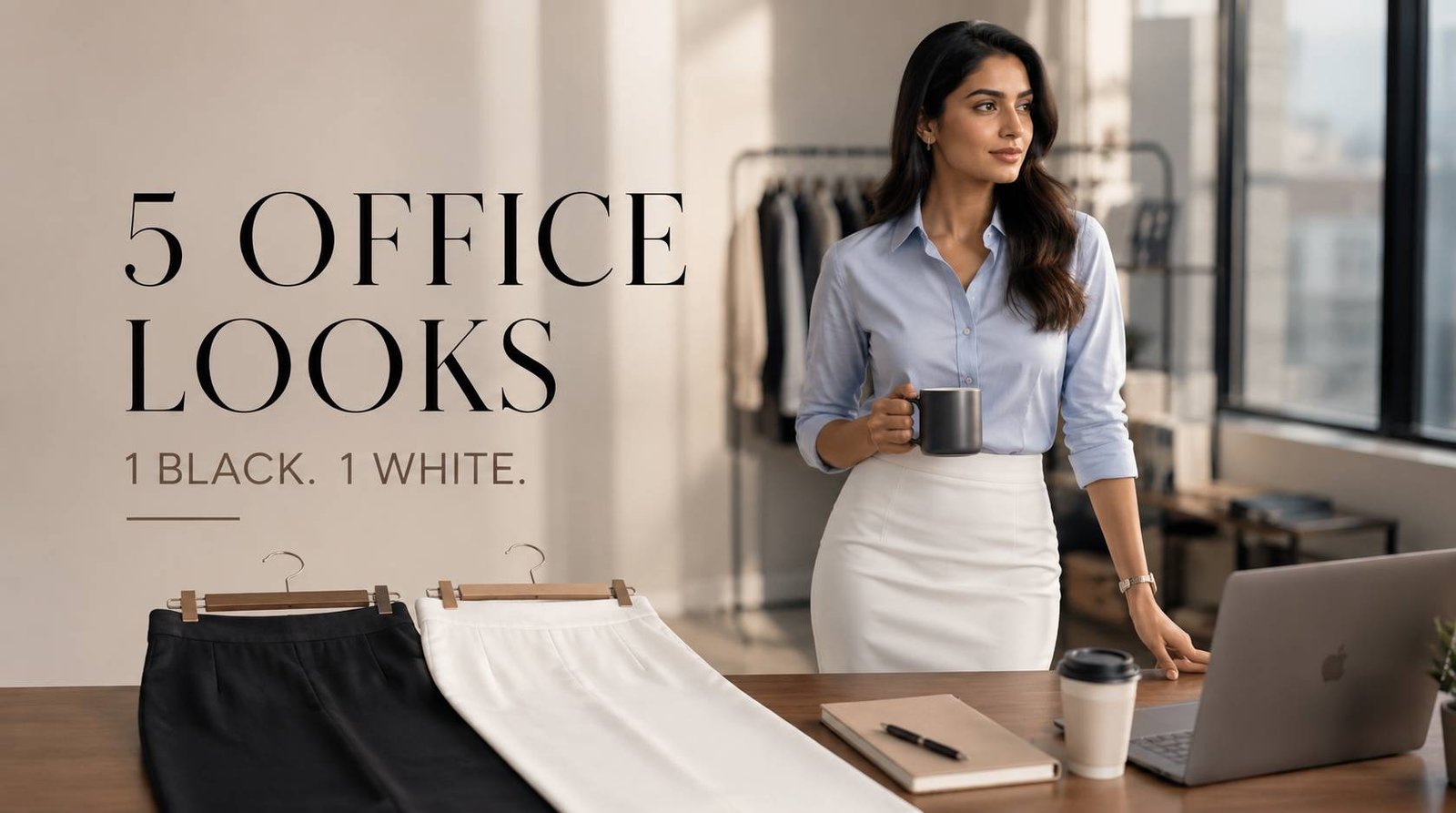
Buying more skirts is not the answer. Most working women already own more formal skirts than they regularly reach for, because the challenge isn't volume — it's connectivity. A skirt that only pairs with two or three things in a wardrobe doesn't earn its keep, no matter how well-cut it is. The skirts that do earn their keep are the ones that connect to everything else, and those are almost always black or white.
The framework here is specific and practical: one formal skirts for women in black, one in white, and five distinct office outfits built around them by rotating shirts, blazers, waistcoats, and tops. The exercise also proves something that sounds counterintuitive until you try it: you get more outfit variety from two skirts plus the tops you already own than from buying six skirts in different colours.
Length and Silhouette: What Reads Professional in Indian Offices
Before the five-outfit framework, the skirt has to fit the context. For formal office wear in India, the most versatile skirt length is knee-length or just below — specifically, a hem that falls within three or four centimetres of the knee. This length sits in a range that reads as formal rather than casual in most Indian workplace dress codes, moves comfortably when climbing stairs or stepping in and out of vehicles, and photographs well in both standing and sitting positions.
Above-the-knee skirts are possible in formal office contexts, but they require more careful pairing and are more sensitive to how the rest of the outfit is constructed. Mini-length is not formal office wear in any Indian context where client interaction is part of the role.
Long formal skirts for women — floor-length or midi — are a distinct category that reads as more fashion-forward and requires a setting that can hold that register. In conservative corporate environments, a floor-length skirt in a formal fabric can work, but it's a statement piece rather than a workhorse. For the five-outfit exercise here, we're working with pencil or A-line silhouettes in the knee-to-midi range.
The silhouette choice between pencil and A-line also matters for sitting comfort. A pencil skirt in a fabric without stretch can restrict movement when sitting for extended periods — something that matters a great deal in an office context where you might be at a desk or in meetings for six or seven hours. Look for pencil skirts with a back vent, a split, or at least two to five percent stretch in the fabric composition.
Outfit One and Two: The Shirt Combinations
The first two looks build directly from the Black Skirt for women — Mid-Week's Raven Black — paired with shirts that sit at opposite ends of the formal spectrum.
Outfit One: Raven Black skirt with a white fitted shirt, tucked in, and a minimal structured belt at the waist if the shirt length allows. No blazer. This is the cleanest, most office-appropriate look in the collection — it reads as sharp and considered without trying. Add a pointed-toe block heel in nude or tan.
Outfit Two: Raven Black skirt with a pale blue fitted shirt (tucked), and a charcoal or mid-grey structured waistcoat over the top. This combination produces the women's formal skirt suits energy — a three-piece read — without requiring a matching suit set. The waistcoat adds formality and structure for meetings or presentations where you want more presence than a shirt alone gives.
Outfit Three and Four: Bringing the White Skirt In
Outfit Three introduces the White Skirt for women — the Glacial White from Mid-Week — paired with a navy or cobalt blue fitted shirt. This is one of the more underused combinations in Indian formal workwear. The navy-on-white reads as confident and precise. It's a strong choice for client-facing days when you want to be noticed without leaning into black's severity.
Outfit Four: Glacial White skirt with a black blazer worn open over a fitted black or charcoal top. This inverts the usual colour logic — the white skirt becomes the lighter element anchoring the dark top half. The contrast is graphic without being harsh. This combination works particularly well in industries like advertising, media, and design where the dress code is formal-modern.
Outfit Five: The Desk-to-Evening Transition
The fifth look is a transition outfit — practical for the working woman who has an after-work commitment and doesn't want to go home first to change. Start with the Raven Black skirt, a silk or satin-finish black top (not a shirt — something with more sheen), and a black blazer. Through the workday, the blazer provides formality. Remove the blazer for an evening event, swap flat formal shoes for a heel, and the outfit changes register entirely.
This desk-to-evening dynamic is where a well-cut formal skirt outperforms formal trousers for most women. Trousers carry a day-at-work visual signature that's harder to shake in the evening. A fitted formal skirt with the right top reads differently when the blazer comes off — more intentional, less like you're still in office mode.
Fabric and Sitting Comfort for All-Day Wear
For Indian working women sitting at desks and in meetings for extended hours, skirt fabric is a genuine comfort consideration. Heavyweight suiting fabrics — thick wool blends, heavy poly-suiting — can bunch, ride up, or feel restrictive after a few hours of sitting. The best performers in formal office skirts are midweight woven fabrics with a small degree of stretch: they hold their shape visually but don't fight your movements.
Mid-Week's formal skirts are built for full workdays specifically — the waistband sits comfortably through extended sitting, and the fabric doesn't develop permanent creases from a day at a desk. For women managing long commutes in Mumbai, Bengaluru, or Delhi before the office day even starts, that fabric performance matters more than most buying guides acknowledge.
The two-skirt base approach — one black, one white — backed by the tops and layers you already own, produces more outfit combinations than most women will exhaust in a month of five-day weeks. Start there before adding a third or fourth skirt. The returns from a third skirt are almost never as high as they look in the shop.