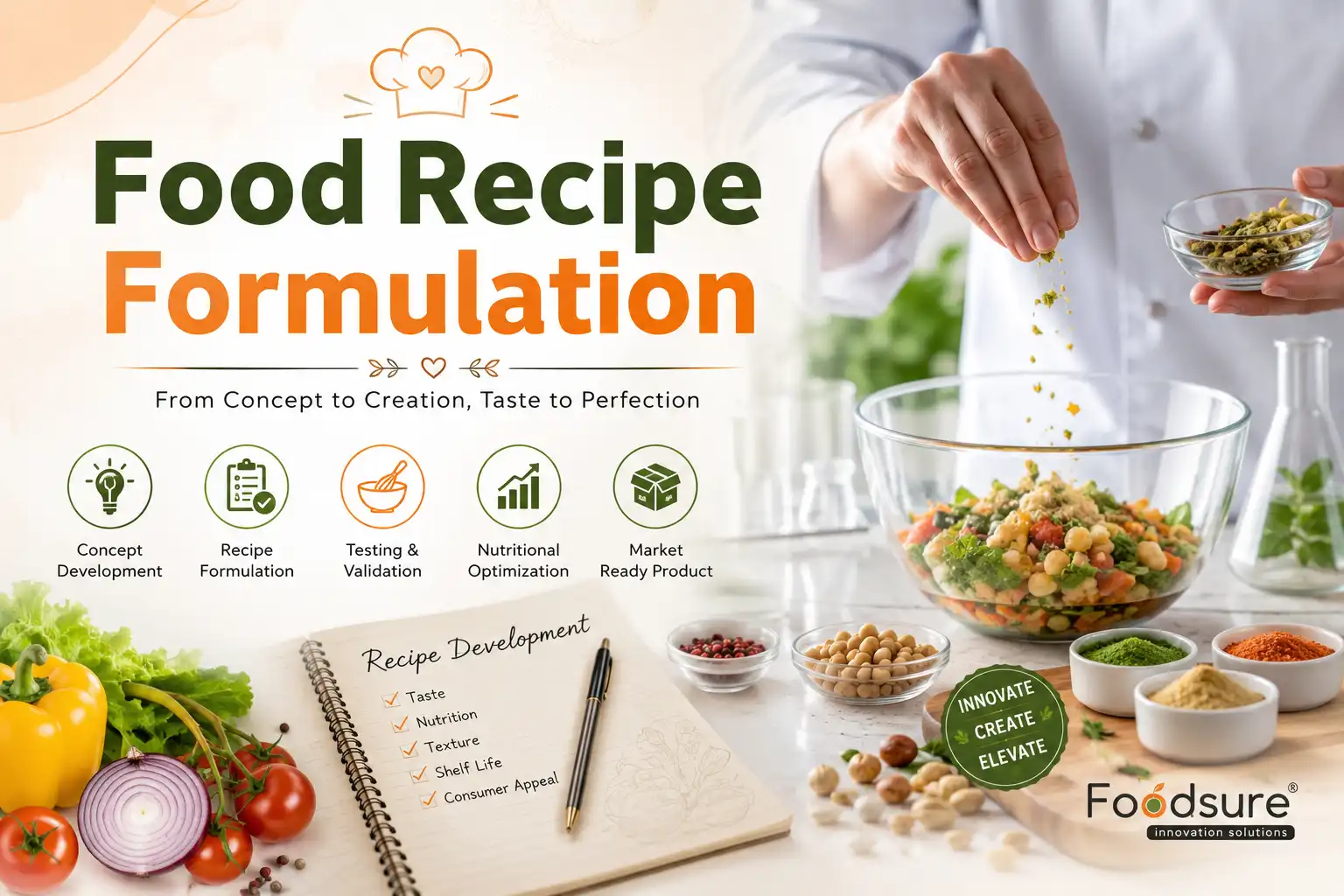
Launching a successful food product is no longer about creating a delicious recipe alone. Consumers today expect consistent taste, balanced nutrition, clean labels, regulatory compliance, long shelf life, and packaging that preserves quality. Behind every successful snack, beverage, bakery item, sauce, supplement, or ready-to-eat meal is a carefully planned Food Recipe Formulation process that transforms an idea into a commercially viable product.
Whether you are a startup, restaurant chain, cloud kitchen, FMCG company, nutraceutical brand, or food entrepreneur, developing a product that performs well in the market requires much more than kitchen trials. Every ingredient must have a purpose, every processing step must be optimized, and every quality parameter must be validated before production begins.
This is where Foodsure supports businesses with scientific product development, helping brands move confidently from concept to commercialization.
What Does Food Recipe Formulation Mean?
At its core, Food Recipe Formulation is the process of designing, balancing, testing, and refining ingredients to create a food product that meets commercial, nutritional, sensory, and regulatory requirements.
Unlike preparing an easy food recipe at home, commercial formulation considers several technical aspects that influence product performance on a larger scale. A recipe that tastes excellent in a home kitchen may fail during mass manufacturing because ingredient interactions, processing temperatures, moisture migration, packaging compatibility, and shelf stability all change when production scales up.
Professional formulation combines culinary creativity with food science to ensure products remain consistent across every batch.
Why Businesses Need Professional Formulation
Food businesses operate in a competitive environment where customers have countless alternatives. A product must deliver quality every time someone purchases it.
Professional formulation helps businesses:
Improve flavor consistency
Optimize ingredient functionality
Reduce production costs
Enhance nutritional value
Increase shelf stability
Support manufacturing efficiency
Meet food safety standards
Prepare products for commercial production
Without a structured development process, businesses often experience inconsistent batches, higher ingredient wastage, customer complaints, and production delays.
The Building Blocks of Commercial Food Development
Every successful product begins with understanding the purpose behind it. Is it designed for athletes? Families? Children? Health-conscious consumers? Premium retail markets?
Once objectives are clear, developers focus on several interconnected elements.
Ingredient Selection
Each ingredient contributes more than taste. Ingredients influence texture, color, aroma, nutrition, processing behavior, and product stability.
Selecting the right combination requires balancing functionality with cost while maintaining consumer appeal.
Nutritional Balance
Modern consumers carefully examine nutrition labels before purchasing products.
Developers work to optimize:
Protein
Fiber
Healthy fats
Vitamins
Minerals
Sugar levels
Sodium content
These improvements often require significant formulation adjustments to maintain taste and texture.
Texture Optimization
Texture strongly influences consumer acceptance.
Depending on the product category, developers evaluate:
Crispness
Creaminess
Softness
Spreadability
Chewiness
Thickness
Mouthfeel
Even minor ingredient modifications can dramatically affect these characteristics.
Flavor Development
Creating memorable flavor profiles involves much more than adding seasonings.
Professional developers evaluate sweetness, acidity, bitterness, saltiness, umami, aroma release, and aftertaste to create a balanced sensory experience.
Scaling Beyond Kitchen Trials
One of the biggest challenges in commercial product development is scaling recipes successfully.
Many businesses assume that multiplying ingredient quantities produces identical results. In reality, larger equipment, mixing times, heating methods, and processing conditions significantly influence product quality.
This is why experienced development teams conduct multiple validation trials before commercial manufacturing begins.
The objective is not simply to reproduce the recipe—but to reproduce the same quality consistently.
Product Categories That Require Scientific Formulation
Commercial formulation supports a wide variety of food sectors, including:
Bakery products
Functional foods
Dairy alternatives
Protein snacks
Ready-to-eat meals
Ready-to-cook products
Sauces and condiments
Frozen foods
Nutraceutical products
Beverage innovations
Each category requires specialized technical knowledge because ingredient behavior differs across processing conditions.
Understanding Consumer Expectations
Today's buyers expect products that combine convenience with quality.
Many consumers search online for food recipes to recreate meals at home, but commercially manufactured products must satisfy additional expectations including safety, consistency, convenience, labeling accuracy, and longer shelf life.
Meeting these expectations requires continuous testing and optimization throughout development.
Common Challenges During Development
Even experienced businesses encounter technical challenges such as:
Ingredient incompatibility
Flavor instability
Moisture imbalance
Texture deterioration
Product separation
Shelf-life limitations
Manufacturing inconsistencies
Identifying the root cause often requires scientific analysis rather than guesswork.
This is where professional research and development becomes valuable.
The Importance of Shelf Stability
Consumers expect products to maintain quality throughout their intended shelf life.
Developers evaluate factors such as:
Moisture control
Oxidation
Microbial safety
Packaging compatibility
Storage conditions
Transportation performance
Extensive validation helps reduce product failures after launch.
Innovation Is Driven by Research
Food innovation continues to evolve as consumers demand healthier, cleaner, and more sustainable products.
Whether inspired by traditional cuisines or modern nutrition trends, successful innovation relies on research, experimentation, and validation.
For example, many entrepreneurs explore traditional indian food recipes and transform them into commercially scalable products with improved nutrition, extended shelf life, and standardized quality for modern markets.
Similarly, products inspired by classic food quiche recipes can be reformulated for frozen retail distribution, healthier ingredient profiles, or high-protein applications.
These transformations require expertise beyond conventional cooking techniques.
Why Food Science Matters
Commercial food development involves much more than selecting ingredients.
Food scientists evaluate:
Functional ingredient interactions
Processing technologies
Product stability
Regulatory considerations
Manufacturing efficiency
Consumer acceptance
Quality assurance
Every adjustment influences multiple product characteristics simultaneously.
Because of this complexity, successful brands invest in structured research rather than relying solely on trial and error.
Foodsure's Approach
Foodsure works with startups, established manufacturers, entrepreneurs, restaurants, cloud kitchens, and nutraceutical brands to simplify commercial product development.
Instead of focusing only on recipes, the team emphasizes practical solutions designed for manufacturing, quality, compliance, and market readiness.
From concept refinement to pilot development, Foodsure helps businesses build products that align with commercial expectations while reducing development risks.
Many technical aspects—including ingredient optimization, processing parameters, stability evaluation, scale-up considerations, regulatory support, and commercialization strategies—require specialized expertise that extends beyond the scope of a general overview. These are typically addressed through project-specific consultation because every product category presents unique formulation challenges.
Choosing the Right Development Partner
Selecting an experienced formulation partner can significantly reduce development time and improve commercial success.
Look for expertise in:
Product innovation
Ingredient functionality
Regulatory guidance
Process optimization
Manufacturing readiness
Quality assurance
Commercial scalability
A collaborative approach allows businesses to focus on branding and growth while technical specialists manage product development complexities.
Final Thoughts
A successful food product is the result of science, creativity, testing, and continuous refinement—not simply a written recipe. Professional Food Recipe Formulation enables businesses to transform innovative ideas into commercially viable products that consistently meet consumer expectations.
As markets become increasingly competitive, investing in structured product development provides a strong foundation for long-term growth. While this guide introduces the fundamentals of Food Recipe Formulation, it intentionally covers only the broader concepts. Every product has unique technical requirements involving ingredients, processing methods, manufacturing conditions, shelf-life validation, regulatory compliance, and commercialization planning.
If you are planning to launch a new food product or improve an existing one, Foodsure can help you navigate these complexities with tailored research and development support, giving your business access to specialized expertise that goes far beyond what can be covered in a single article.
Tags : Food Recipe Formulation