Enterprise AI Readiness: How to Prepare Your Business for AI Adoption
By Harris Anderson 25-08-2026 76
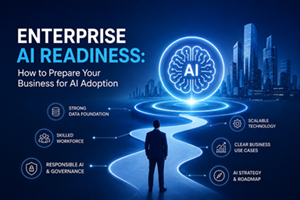
Artificial intelligence is becoming an important part of enterprise digital transformation. Businesses are exploring AI to automate repetitive processes, improve customer experiences, analyze data, and support better decision-making. However, successful AI adoption requires more than choosing an AI tool. Enterprises need the right data, technology infrastructure, people, processes, and governance framework.
What Is Enterprise AI Readiness?
Enterprise AI readiness refers to an organization's ability to successfully adopt, implement, and scale AI technologies. It involves evaluating existing data infrastructure, applications, workflows, technical capabilities, security practices, and organizational skills.
A readiness assessment helps businesses identify gaps before investing heavily in AI. It can also help determine which AI initiatives are technically feasible and likely to deliver meaningful business value.
1. Assess Your Data Infrastructure
Data is the foundation of most enterprise AI applications. Businesses should evaluate where their data is stored, how it is collected, and whether it is accurate, accessible, and properly structured.
Organizations may need to integrate data from CRM, ERP, customer platforms, cloud systems, databases, and other business applications. Improving data quality and establishing reliable data pipelines can significantly strengthen the foundation for future AI projects.
2. Evaluate Your Technology Environment
AI solutions need infrastructure that can support development, deployment, integration, and ongoing monitoring. Enterprises should review their cloud environment, applications, APIs, databases, security architecture, and computing capabilities.
The goal is not necessarily to replace existing technology. Instead, businesses should determine how AI can integrate with their current environment while maintaining scalability, performance, and security.
3. Identify High-Value AI Use Cases
AI adoption should begin with business problems rather than technology trends. Enterprises can identify processes where AI could improve efficiency, reduce costs, increase accuracy, or provide better insights.
Potential use cases include intelligent customer support, predictive analytics, document processing, fraud detection, recommendation systems, workflow automation, and enterprise knowledge assistants.
Each use case should be evaluated based on business impact, technical feasibility, data availability, complexity, and expected ROI.
4. Prepare Your Workforce
AI adoption also requires organizational readiness. Employees need to understand how AI will affect existing workflows and how they can use new systems effectively.
Enterprises may need AI training, technical upskilling, new roles, and clear responsibilities for managing AI systems. Combining human expertise with AI capabilities can help organizations achieve better results while maintaining appropriate oversight.
5. Establish AI Governance and Security
Security, privacy, and responsible AI practices should be considered before deployment. Enterprises need appropriate controls for data access, privacy, model monitoring, human oversight, and compliance.
A strong governance framework helps organizations manage risks such as inaccurate AI outputs, unauthorized data access, model drift, and inappropriate use of sensitive information.
6. Create an AI Adoption Roadmap
Once readiness gaps and priority use cases are identified, businesses can develop an AI roadmap. The roadmap should define short-term pilots as well as longer-term initiatives.
Starting with a focused proof of concept allows organizations to test assumptions, measure results, gather user feedback, and identify technical challenges before expanding AI across the enterprise.
How AI Consulting Services Can Help
For organizations that lack internal AI expertise, AI Consulting Services can provide support across the AI adoption lifecycle. Consultants can help assess organizational readiness, identify high-value use cases, develop an AI strategy, recommend technology architecture, establish governance practices, and plan implementation.
The objective is to create an AI roadmap that aligns technology investments with measurable business outcomes.
Conclusion
Enterprise AI readiness is a strategic process rather than a one-time technology upgrade. By strengthening data infrastructure, evaluating technology capabilities, prioritizing practical use cases, preparing employees, and establishing governance, businesses can create the foundation needed for successful AI adoption.
A structured readiness approach enables enterprises to move from AI experimentation toward scalable solutions that deliver lasting business value.