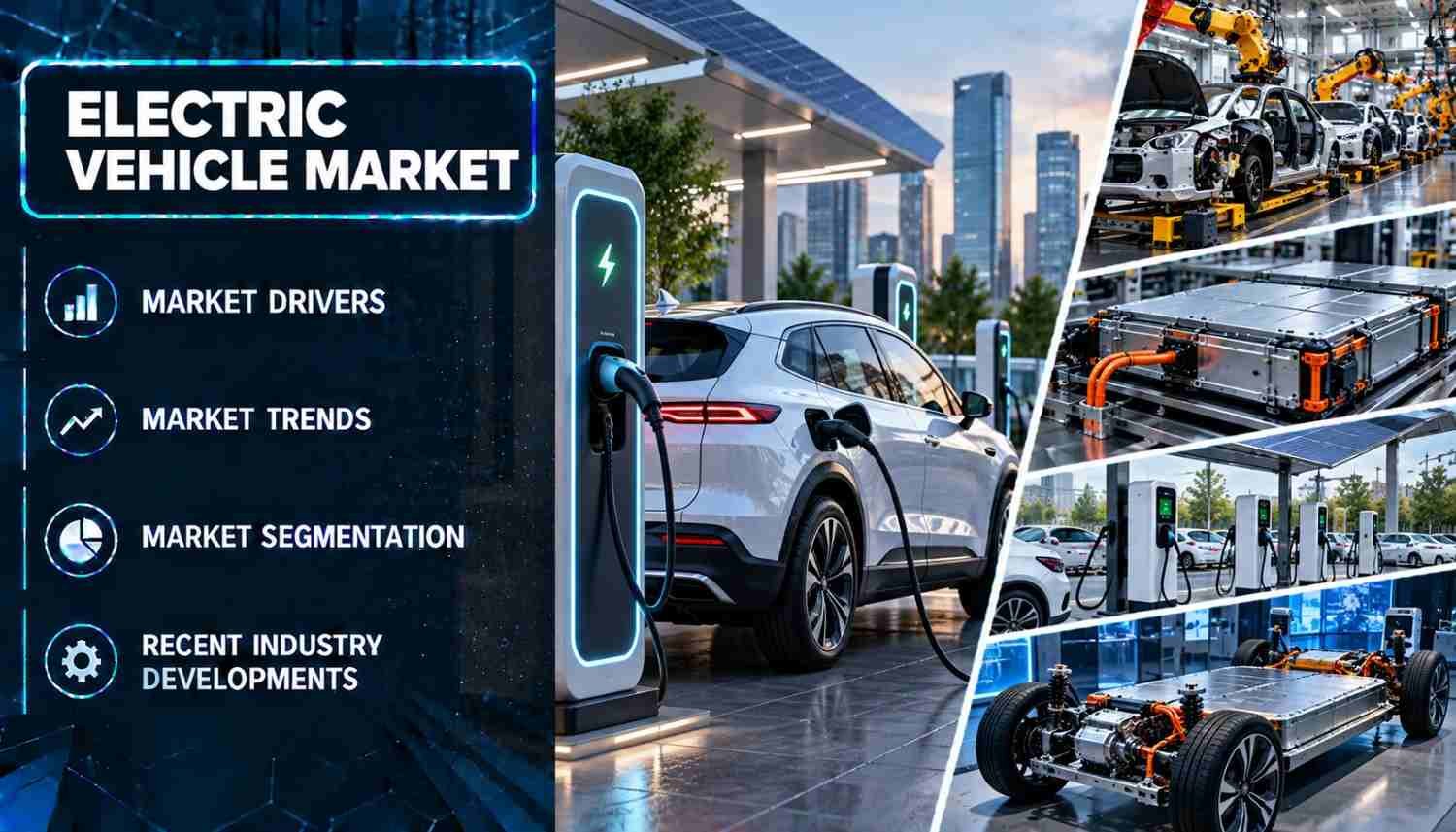
IMARC Group, a leading global market research and management consulting firm, has published its latest market intelligence report on the electric vehicle market. The global electric vehicle market size was valued at USD 917.3 Billion in 2025. Looking forward, IMARC Group estimates the market to reach USD 4,886.2 Billion by 2034, exhibiting a CAGR of 20.43% from 2026-2034, driven by rising environmental sustainability concerns, rapid advancements in battery technology, expanding charging infrastructure, supportive government policies and incentives, growing public awareness, and increasing investments in renewable energy sources worldwide.
The electric vehicle market is witnessing steady expansion as governments, automakers, and consumers align around cleaner mobility. Asia Pacific currently leads with a regional share of over 46.5%, while passenger vehicles account for around 73.5% of the market by vehicle type. Global battery demand has already exceeded 750 GWh in a single year, a 40% jump, with China alone contributing 415 GWh. Meanwhile, charging networks are scaling quickly, with public charging points projected to grow more than sixfold over the coming decade.
How AI is Reshaping the Future of the Electric Vehicle Market
- AI-Powered Battery Management and Range Optimization: Machine learning models analyze cell temperature, charge cycles, driving patterns, and terrain in real time to extend battery life, improve range prediction, and reduce degradation. This gives automakers and fleet operators greater confidence in vehicle performance and resale values, which directly addresses range anxiety among first-time buyers.
- Intelligent Charging and Grid Integration: AI-driven platforms are optimizing when and where vehicles charge by balancing electricity prices, grid load, and renewable energy availability. Google, for instance, has brought AI-powered charging guidance in Maps to over 350 car models through Android Auto, recommending charging stops and estimating battery level on arrival. Smart charging and vehicle-to-grid services are also moving into mainstream rollouts.
- Predictive Maintenance and Autonomous Driving Development: Connected EVs generate large volumes of data that AI uses to flag component wear before failures occur, cutting downtime for taxi, delivery, and public transport fleets. The same data pipelines feed advanced driver assistance and autonomous driving systems, accelerating innovation across passenger and commercial vehicle categories.
Electric Vehicle Market Trends and Drivers
The global electric vehicle market is witnessing strong growth momentum, fueled by the convergence of climate commitments, falling battery costs, and a rapidly maturing charging ecosystem. Conventional fossil fuel vehicles remain a major contributor to greenhouse gas emissions and urban air pollution. According to the World Meteorological Organization, atmospheric carbon dioxide concentration has risen by 11.4% over the past two decades. Electric vehicles produce zero tailpipe emissions, which is why city administrations, environmental groups, and consumers increasingly favor them as a practical route to cleaner air and lower emissions.
Battery innovation is another decisive force. Modern lithium-ion batteries paired with advanced battery management systems have extended driving ranges and improved energy density, turning EVs into dependable daily-use vehicles. Manufacturers are now prioritizing solid-state and high-energy-density chemistries to cut charging times further. Charging infrastructure is expanding in parallel. Fast-charging corridors along highways, workplace and residential chargers, and urban charging hubs are being deployed at scale, often integrated with renewable energy sources to reinforce the sustainability case for EVs.
Government policy continues to shape demand across regions:
- United States: The Bipartisan Infrastructure Law directs $5 billion toward EV charging along highway alternative fuel corridors, complemented by $2.5 billion in competitive grants for additional charging construction. Federal and state tax credits and rebates further reduce ownership costs.
- India: Supportive policies and incentives, including the PM E-DRIVE scheme with an outlay of around Rs 10,900 crore, have helped drive a 16% rise in half-year EV registrations, with 16,344 public charging stations and 10,756 fast charging points now operating, according to PIB.
- Europe: Electric vehicles now make up 22.7% of new car registrations and 7.7% of van registrations, according to the European Environment Agency, while EU rules require all new cars and vans to be zero-emission by the mid-2030s.
- China: The country has set a target for EVs to account for 40% of all vehicle sales, while promoting smarter charging behavior to shift more charging to off-peak hours.
- Middle East: The UAE's National Electric Vehicle Strategy aims for EVs to make up 50% of all vehicles on the road by mid-century, while Saudi Arabia is investing in green mobility under its national Vision program.
Electric Vehicle Industry Segmentation
The report has segmented the electric vehicle market into the following categories:
Breakup By Component:
- Battery Cells and Packs
- On-Board Charger
- Fuel Stack
Battery cells and packs form the technological core of the market, supported by rising R&D investment and demand for higher energy density and longer range. On-board chargers benefit from the global buildout of charging networks and the push for shorter charging times. Fuel stacks are gaining attention as hydrogen fuel cell technology emerges as a promising clean energy source for future electric mobility, backed by government research funding.
Breakup By Charging Type:
- Slow Charging
- Fast Charging
Slow charging leads the market with around 71.2% share. It is cost-effective, easy to install, places lower demand on the electrical grid, and is gentler on battery life, making it ideal for overnight home charging and long-duration workplace parking.
Breakup By Propulsion Type:
- Battery Electric Vehicle (BEV)
- Fuel Cell Electric Vehicle (FCEV)
- Plug-In Hybrid Electric Vehicle (PHEV)
- Hybrid Electric Vehicle (HEV)
Hybrid electric vehicles lead with around 61.3% share. They bridge conventional combustion engines and fully electric models, offering lower emissions and better fuel efficiency, which appeals to buyers who want savings without changing refueling habits. Rising fuel prices and government incentives are strengthening this segment.
Breakup By Vehicle Type:
- Passenger Vehicles
- Commercial Vehicles
- Others
Passenger vehicles account for around 73.5% of the market. Rapid urbanization, rising disposable incomes in emerging economies, connected car features, favorable financing options, and the spread of ride-sharing and car-sharing services are all encouraging electric passenger car adoption.
Breakup By Region:
- North America (United States, Canada)
- Asia Pacific (China, Japan, India, South Korea, Australia, Indonesia, Others)
- Europe (Norway, Netherlands, Sweden, United Kingdom, France, Germany, Others)
- Latin America (Brazil, Mexico, Argentina, Colombia, Others)
- Middle East and Africa (Turkey, Saudi Arabia, Iran, United Arab Emirates, Others)
Asia Pacific dominates the global electric vehicle market with a share of over 46.5%, driven by stringent emission norms, rapid urbanization, air quality concerns, battery manufacturing strength, and a growing middle class. China leads on production and subsidies, while India emphasizes affordable electric two-wheelers for urban and rural mobility. In North America, the United States accounts for around 89.5% of the regional market, supported by federal incentives and companies such as Tesla and Rivian.
Competitive Landscape
The report provides a comprehensive analysis of the competitive landscape in the electric vehicle market with detailed profiles of all major companies, including:
- BYD Company Limited
- BMW Group
- Chevrolet (General Motor Company)
- Ford Motor Company
- Hyundai Motor Group
- Mercedes-Benz Group AG
- Mitsubishi Motors Corporation
- Nissan Motor Corporation
- Tesla, Inc.
- Toyota Motor Corporation
- Volkswagen Group
What Does The Full Report Cover?
If you are tracking the electric vehicle market for investment decisions, market entry planning, competitive benchmarking, or strategic advisory, IMARC Group's report gives you everything in one place:
- Complete market sizing with revenue and unit forecasts covering the full projection period
- Quantified growth driver analysis across component, charging type, propulsion type, vehicle type, and regional markets
- Sub-segment breakdowns for battery cells and packs, on-board chargers, fuel stacks, slow and fast charging, BEV, FCEV, PHEV, HEV, passenger and commercial vehicles with individual share data
- Country-level data for 22 markets including China, Japan, India, South Korea, the United States, Germany, France, the United Kingdom, Saudi Arabia, the UAE, and Brazil
- Competitive profiles of leading companies with strategic landscape assessment
- Porter's Five Forces analysis and insights on industry drivers, challenges, and opportunities
Recent News and Developments in Electric Vehicle Market
- August: Hyundai Motor Group selected Kaluza as its global technology partner for EV smart charging across its brands. The rollout begins with Kia and Hyundai in the UK, followed by Australia and global expansion, and lays the groundwork for vehicle-to-grid services.
- April: IONNA, the charging network founded by eight leading automakers including BMW, General Motors, Honda, Hyundai, Kia, Mercedes-Benz, Stellantis, and Toyota, announced a strategic partnership with Circle K to expand high-power EV charging access across the United States.
- March: Volkswagen and Rivian passed a key milestone in their joint venture when the first vehicle using Rivian's software and electrical architecture reached its trigger point, unlocking a USD 1 Billion investment from Volkswagen.
- December: BYD and Eskom formalized a partnership to roll out 200 to 300 public charging stations across South Africa, with BYD also signaling plans to adopt ultra-fast 1MW charging technology as compatible vehicles arrive.
- November: Switch Mobility partnered with Vertelo to deploy 1,000 electric commercial vehicles across India over the next three to five years, with Vertelo leasing and funding the electric buses and light commercial vehicles to ease financial barriers for businesses and municipalities.
Note: If you require specific details, data, or insights that are not currently included in the scope of this report, we are happy to accommodate your request. As part of our customization service, we will gather and provide the additional information you need, tailored to your specific requirements. Please let us know your exact needs, and we will ensure the report is updated accordingly to meet your expectations.
Key Questions This Report Answers
- What is the current global electric vehicle market size and what is its projected value?
- Which charging type, propulsion type, and vehicle type segments hold the largest shares in the global electric vehicle market?
- What are the key drivers of global electric vehicle market growth?
- Which region dominates the global electric vehicle market and why?
- How are battery innovation, charging infrastructure expansion, and government incentives reshaping competitive strategies in the electric vehicle industry?
- Who are the top companies in the global electric vehicle market and what are their competitive strategies?
- What are the investment and market entry opportunities across battery, charging, hybrid, and commercial electric vehicle segments?
About Us
IMARC Group is a global management consulting firm that helps the world's most ambitious changemakers to create a lasting impact. The company provides a comprehensive suite of market entry and expansion services. IMARC offerings include thorough market assessment, feasibility studies, company incorporation assistance, factory setup support, regulatory approvals and licensing navigation, branding, marketing and sales strategies, competitive landscape and benchmarking analyses, pricing and cost research, and procurement research.
Media and Sales Contact
IMARC Group
Email: sales@imarcgroup.com
United States: +1-201-971-6302
India: +91-120-433-0800
United Kingdom: +44-753-714-6104
Tags : Electric Vehicle Market