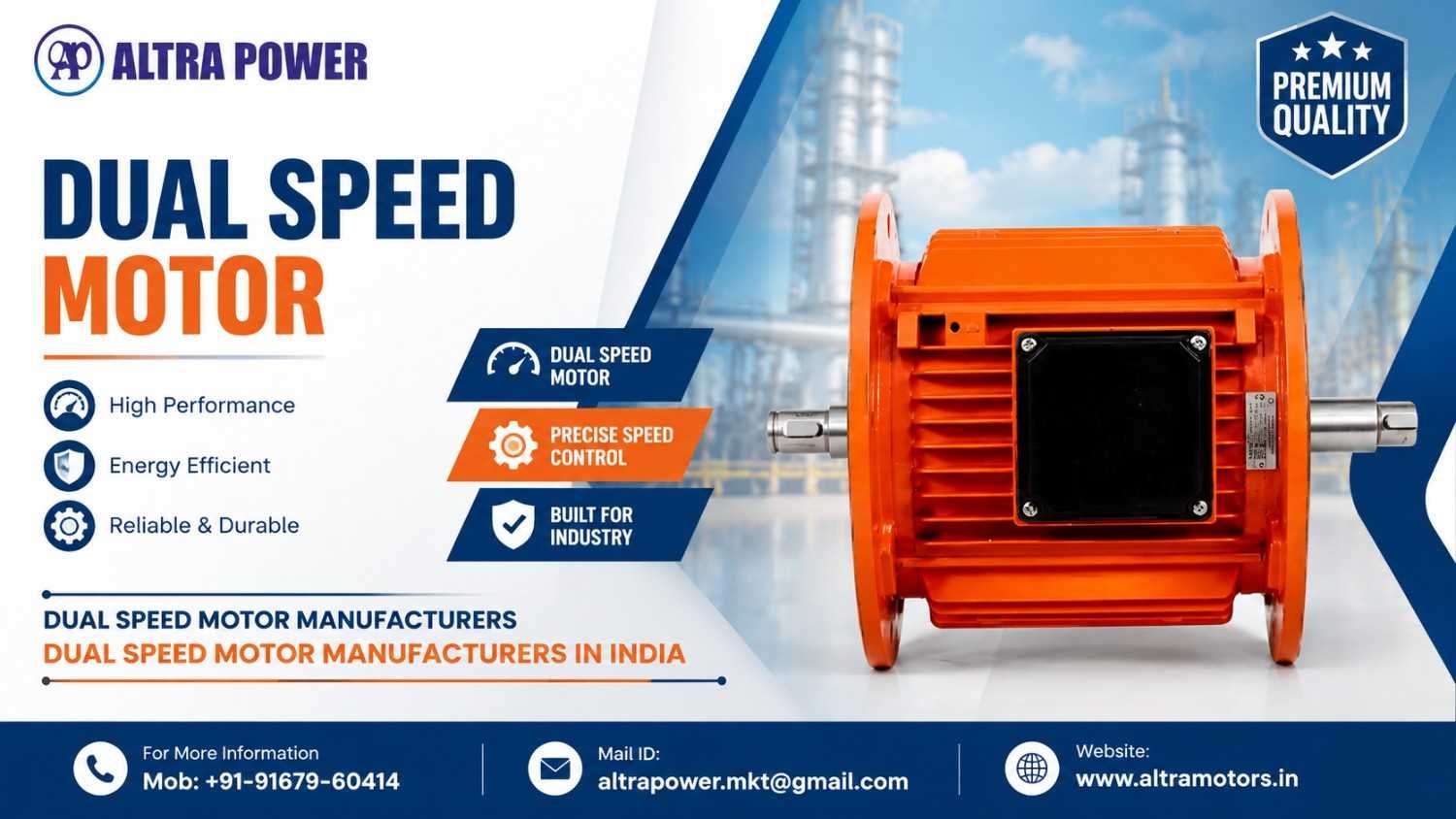
A procurement manager in Ludhiana once told us he'd rejected a shipment because the motor's second speed setting drifted by nearly 12% under load. The specification sheet said it wouldn't. That's the gap between a catalog and a factory floor. If you're sourcing a Dual Speed Motor for production equipment, packaging lines, or industrial fans, the spec sheet is only the starting point what happens under sustained load is where suppliers get separated from manufacturers.
Altra Power builds Dual Speed Motor for buyers who've already been burned once by a supplier who treated "dual speed" as a marketing term rather than an engineering commitment.
What "Dual Speed" Actually Means on a Spec Sheet
Not every motor sold as dual speed uses the same winding configuration, and this is the detail most buyers skip entirely.
Winding Configurations We Manufacture
- Consequent pole (single winding) for applications where cost matters more than speed ratio flexibility
- Two separate windings (PAM) for buyers who need independent torque characteristics at each speed
- Dahlander configuration the most common request from packaging and conveyor clients, offering a fixed 2:1 speed ratio
Output Range
We manufacture from 0.5 HP to 15 HP across frame sizes 71 to 132, in 4/8 pole and 4/2 pole combinations. Voltage compatibility runs 230V single-phase through 415V three-phase, and every unit ships with an IP55 protection rating as standard IP65 on request for buyers in dust-heavy or coastal environments.
One detail buyers overlook: the torque curve at low speed isn't a straight-line fraction of the high-speed torque. On a Dahlander winding, low-speed torque typically drops to around 40-45% of rated high-speed torque, not 50%. If your application needs consistent torque at both settings, that gap needs to be engineered around before you place the order, not discovered after installation.
What to Actually Check Before You Sign a PO
Here's the criteria that separates a serious manufacturer from someone relabeling an OEM motor. Five things, and what a bad answer sounds like for each.
- Insulation class documentation. A bad answer: "It's Class F, don't worry about it." A real answer names the actual insulation system tested and cites the IS/IEC standard it was tested against.
- Speed-switching mechanism reliability testing. A bad answer avoids cycle-count data entirely. Ask how many switch cycles the contactor and winding were tested for if the supplier doesn't have a number, they haven't tested it.
- Bearing life at continuous duty (S1). A bad answer says "long-lasting." A real answer gives you an L10 bearing life figure in hours.
- Noise and vibration data at both speeds, not just high speed. Most suppliers only test and report vibration at the higher RPM setting because that's the number that looks better on paper.
- Post-sale technical support for rewinding or field service. A bad answer redirects you to a generic customer care line. Ask specifically whether the manufacturer's own engineers handle warranty claims or whether it's outsourced to a third-party service network.
A supplier who says "we'll handle defects case by case" doesn't have a policy. That's a negotiation you'll lose after the shipment lands and your production line is already down.
Why Buyers Choose a Manufacturer Over a Trading Company
Sourcing Dual Speed Motor directly from a manufacturer protects your margin and your production schedule in ways a reseller relationship can't.
- Direct factory pricing removes the 12-18% markup that trading companies typically add between manufacturer and buyer.
- Faster fault resolution. When a rewind or a warranty claim needs the original winding data, you're talking to the people who built it, not a reseller checking with someone else.
- Custom winding on request. Non-standard voltage, frequency, or speed ratio requirements get engineered in-house instead of routed to a third party and marked up again.
- Batch consistency across repeat orders. The same production line, same QC process, same winding technician team which matters enormously if you're placing recurring orders across a fiscal year.
- Traceable documentation. Test certificates, material certs, and IS/IEC compliance paperwork come from the actual manufacturing unit, not a photocopy from three hands back.
- Shorter lead times on repeat SKUs, since the tooling and winding specs are already on file rather than re-sourced each time.
None of this matters if the motor fails in month four. It matters because it changes how fast a failure gets resolved when not if something eventually goes wrong.
Manufacturing Base and What It Means for Your Supply Chain
Altra Power's production facility is located in India's northern industrial belt, within reach of the country's major rail freight corridors and the Delhi-NCR logistics network. That location isn't incidental to sourcing decisions.
For buyers in northern and central India, this cuts inland freight time by roughly 2-4 days compared to sourcing from motor manufacturing clusters in the south or west, which matters when a packaging line is down and waiting on a replacement unit. For export buyers, proximity to ICD facilities and container freight stations shortens the gap between production sign-off and vessel booking. We ship Dual Speed Motor to buyers across domestic industrial hubs and to export markets across the Middle East, Southeast Asia, and East Africa.
About Altra Power
We started winding motors in 2013, and for the first four years we were almost entirely a subcontract winding shop for other brands before we started building and certifying our own line. That history matters because it means our winding technicians have handled failure patterns from dozens of other manufacturers' designs before they ever touched ours they know what breaks and why.
We stopped offering aluminum-wound motors in our dual speed range in 2020 after two consecutive buyers in coastal export markets reported early winding degradation under high humidity. We moved the entire dual speed line to copper winding as standard, and we absorbed the cost difference rather than passing it through as a premium SKU. That's not a claim in a brochure. That's a production decision our finance team still brings up.
Our QC floor tests every unit at both speed settings before it leaves the facility not a sample batch, every unit. It slows output. We've kept it anyway.
Send us your required HP, frame size, and speed ratio, and we'll respond with pricing and lead time within 24 business hours. Minimum order quantity starts at 10 units for standard configurations; custom windings carry a 25-unit MOQ. If you're evaluating us against another supplier, send both spec sheets we'll tell you honestly where ours is stronger and where it isn't. Reach out to Altra Power directly through our product range page to start the conversation.
The Bottom Line on Sourcing a Dual Speed Motor
A Dual Speed Motor Manufacturer in India is a mechanical commitment disguised as a spec sheet line item. The manufacturers who test both speed settings, document bearing life honestly, and answer switch-cycle questions without deflecting are the ones worth a long-term supply relationship. Altra Power builds toward that standard because we've watched what happens on the buyer's end when a supplier doesn't.
Frequently Asked Questions
What's the typical lead time for a dual speed motor order from Altra Power?
Standard configurations ship in 15-18 working days from PO confirmation. Custom windings run closer to 25-30 days because the tooling and testing cycle is longer we won't quote you a shorter number just to win the order.
Can you match an existing OEM dual speed motor spec for a replacement order?
In most cases, yes, if you can send us the nameplate data or the original winding diagram. Where the original manufacturer used a proprietary frame size we don't stock, we'll tell you upfront instead of quoting a "close enough" substitute.
Do you export to Africa and the Middle East, and what certifications ship with the motor?
Yes our largestDual Speed Motor export volume goes to the UAE, Kenya, and Nigeria. Every export order ships with test certificates and a certificate of origin; CE marking is available on request for specific markets but isn't standard on every unit.
What's the difference between your Dahlander winding and a two-winding PAM motor?
A Dahlander motor uses a single winding reconfigured for two speeds and is cheaper, but locks you into a fixed 2:1 ratio. A PAM motor uses two independent windings, costs more, and gives you flexibility on the actual speed ratio and independent torque tuning at each setting.
How do I know if I need IP55 or IP65 protection for my application?
IP55 covers standard indoor industrial environments with normal dust exposure. If your Dual Speed Motor is running near washdown areas, coastal humidity, or heavy airborne particulate think flour mills or cement handling IP65 is worth the added cost. We'll ask about your environment before quoting; if you're unsure, describe the floor conditions and we'll recommend one.