Introduction
A reliable networking system plays an important role in maintaining fast and stable connectivity. Whether you are setting up a home office, upgrading a corporate network, or improving internet connectivity, choosing the right Ethernet cable is essential. Cat5 and Cat5e are two commonly used cable categories.
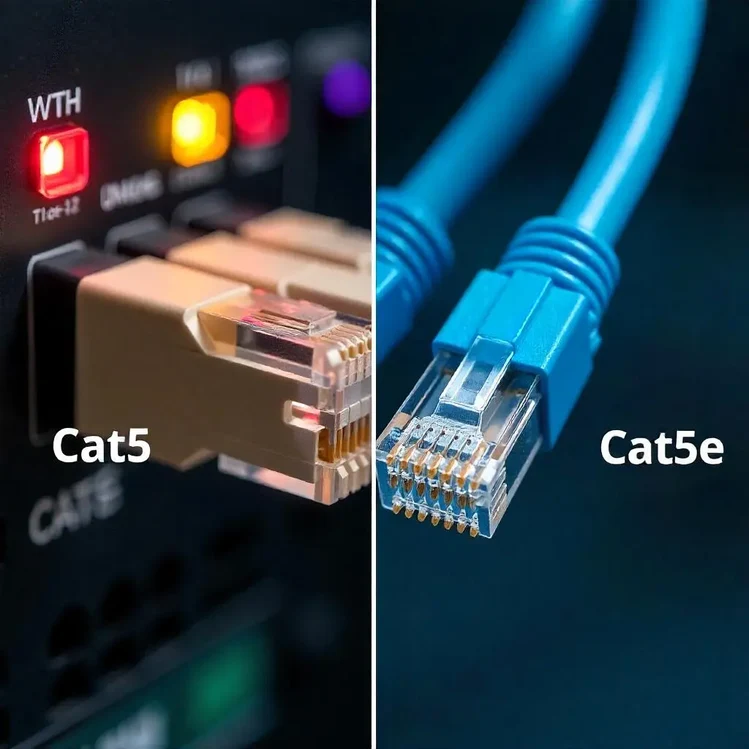
This blog explains the difference between Cat5 and Cat5e cables, including their features, performance, applications, and suitability for different networking requirements in India.
What Are Cat5 and Cat5e Cables?
1. Cat5 Cable
Cat5 cable was introduced in the 1990s and became widely used for Local Area Networks (LANs). It uses twisted-pair wiring and can support data speeds of up to 100 Mbps with a bandwidth of up to 100 MHz.
Cat5 cables are suitable for basic networking applications such as computer networks, internet connections, communication systems, and certain video applications. However, because modern networks require higher speeds, Cat5 has become less common for new installations.
2. Cat5e Cable
Cat5e cable is an enhanced version of Cat5. The "e" stands for "enhanced," and the cable is designed to provide better performance and improved resistance to signal interference.
Cat5e supports data speeds of up to 1 Gbps (1000 Mbps) and bandwidth of up to 100 MHz. Improved cable design and reduced crosstalk make Cat5e a more reliable choice for modern home, office, and commercial networks.
Key Differences Between Cat5 and Cat5e Cables
1. Performance
The biggest difference between Cat5 and Cat5e is their network performance. Cat5 generally supports speeds of up to 100 Mbps, while Cat5e can support Gigabit Ethernet speeds of up to 1 Gbps under suitable conditions.
This makes Cat5e more suitable for applications that require faster data transfers, video conferencing, online gaming, cloud applications, and large file transfers.
2. Speed and Bandwidth
Both Cat5 and Cat5e cables are rated for bandwidth of up to 100 MHz. However, Cat5e offers significantly better performance for Gigabit Ethernet because it is designed with tighter performance specifications and improved control of signal interference.
For modern internet connections and local networks, Cat5e is generally the better option.
3. Crosstalk and Signal Interference
Crosstalk occurs when signals from one wire interfere with signals travelling through another wire. Cat5e has improved specifications for controlling crosstalk compared with older Cat5 cabling.
This makes Cat5e more reliable in environments where several network cables are installed close to one another, such as offices, server rooms, and commercial buildings.
4. Cable Construction
Both Cat5 and Cat5e use twisted-pair cable construction. However, Cat5e cables are manufactured to meet more demanding specifications for signal quality and crosstalk performance.
The improved construction helps maintain reliable data transmission and makes Cat5e better suited for higher-speed networking.
5. Cost
Cat5 cables can be less expensive because they are an older networking standard. However, the price difference between Cat5 and Cat5e can be relatively small compared with the performance benefits offered by Cat5e.
For a new installation, Cat5e is generally a more practical choice because it provides better performance and supports Gigabit networking.
Applications of Cat5 and Cat5e Cables in India
The choice between Cat5 and Cat5e depends on the required network speed, installation environment, budget, and future requirements.
1. Home Connectivity
For basic home activities such as web browsing, email, social media, and standard internet usage, Cat5 can still work in some existing installations.
However, with the increasing use of smart TVs, gaming consoles, computers, security cameras, and other connected devices, Cat5e is a better option for most new home network installations.
2. Small and Medium-Sized Businesses
Small and medium-sized businesses in India increasingly depend on cloud applications, VoIP, video conferencing, online collaboration, and fast file transfers.
While Cat5 can handle basic networking requirements, Cat5e is generally more suitable because it supports Gigabit Ethernet and provides improved resistance to crosstalk.
3. Educational Institutions
Schools, colleges, coaching centres, and other educational institutions often need reliable connectivity for computers, smart classrooms, digital learning platforms, and online resources.
Cat5e can be a suitable choice where multiple devices need reliable and fast network connectivity.
4. Data Centres and Commercial Networks
Modern data centres and commercial networking environments generally require higher-performing cabling solutions. Cat5e may be used for certain network connections, although higher-category cables such as Cat6 and Cat6a are often preferred for newer high-performance installations.
The choice should be based on the required network speed, infrastructure, and future expansion plans.
Future of Cat5 and Cat5e Cables
Networking technology continues to evolve, and newer cable categories are becoming increasingly popular. Cat6 and Cat6a offer higher performance and are better suited to many modern and future-ready network installations.
However, Cat5e remains a practical and cost-effective option for homes, offices, and other applications where Gigabit Ethernet is sufficient.
Installation Considerations
Proper installation is important to achieve reliable network performance from Cat5 or Cat5e cables.
- Avoid Electrical Interference: Keep Ethernet cables away from power cables and other sources of electrical interference whenever possible.
- Use Compatible Connectors: Use suitable RJ45 connectors, keystone jacks, and network accessories designed for the cable category.
- Maintain Proper Cable Length: For standard Ethernet installations, keep the total channel length within the recommended 100-metre limit.
- Avoid Excessive Bending: Do not sharply bend, crush, or tightly bundle Ethernet cables, as this can affect signal performance.
- Plan for Future Requirements: When installing new network cabling, consider future speed requirements and choose a cable category that can support your expected network upgrades.
Conclusion
Understanding the difference between Cat5 and Cat5e cables is important when choosing the right networking solution. While Cat5 can still be useful for basic or existing networks, Cat5e provides better performance, improved crosstalk control, and support for Gigabit Ethernet.
For most new home and office installations in India, Cat5e is a more practical and future-ready choice. For higher-speed networking requirements, users can consider advanced categories such as Cat6 and Cat6a.
FEDUS provides a range of networking and connectivity products designed for different home, office, and commercial requirements. Choosing the right Ethernet cable can help ensure a stable, reliable, and efficient network.