The logistics industry has changed significantly in recent years. Customers expect faster deliveries, accurate tracking, flexible shipping options, and timely updates. At the same time, logistics companies have to deal with rising operational costs, multiple transportation partners, complex supply chains, and constantly changing customer demands.
Managing all of this with spreadsheets, disconnected applications, phone calls, and manual data entry can quickly become difficult. As a logistics business grows, these traditional methods often create more problems than they solve.
This is where custom logistics software can make a real difference. Instead of forcing business operations to fit into a standard software package, a custom solution can be designed around the company's actual workflows, challenges, and growth plans.
What Is Custom Logistics Software?
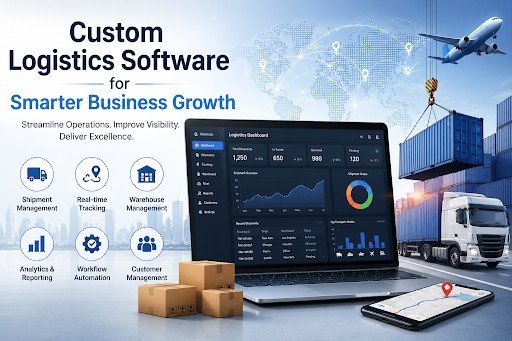
Custom logistics software is a technology solution developed specifically for the requirements of a logistics, transportation, freight, or supply chain business. It can bring different operational activities together within a single system.
Depending on the company's requirements, the software may include features for:
- Shipment and order management
- Fleet management
- Warehouse management
- Route planning
- Driver management
- Real-time shipment tracking
- Inventory management
- Freight and delivery management
- Customer management
- Billing and invoicing
- Reporting and analytics
- Third-party integrations
The important difference is flexibility. A logistics company can decide which processes should be automated and which information needs to be available to employees, drivers, managers, customers, and other stakeholders.
Why Are Logistics Companies Moving Toward Custom Solutions?
Growth brings complexity.
A small logistics company might manage deliveries using spreadsheets and a few separate applications. This may work when there are only a handful of vehicles and shipments. But as order volumes increase, the same approach becomes harder to maintain.
For example, imagine a company managing hundreds or thousands of shipments every day. Information may be spread across emails, spreadsheets, accounting software, GPS systems, warehouse applications, and customer databases.
Employees then spend valuable time moving information from one system to another.
There is also a greater chance of:
- Duplicate data
- Incorrect shipment information
- Missed updates
- Scheduling conflicts
- Billing errors
- Delayed deliveries
- Poor communication
- Limited visibility into operations
Custom logistics software can connect these processes and create a more organized operating environment.
1. Automating Repetitive Logistics Processes
One of the biggest benefits of custom software is automation.
Logistics businesses have many repetitive activities. Employees may need to enter shipment details, assign vehicles, update delivery statuses, send customer notifications, prepare invoices, and generate reports.
Doing these tasks manually every day consumes time.
With a properly designed logistics system, many of these activities can happen automatically. For instance, when a shipment is created, the system can assign a tracking number, update the order status, notify the appropriate team, and trigger the next step in the workflow.
Automation does not mean removing people from the process. Instead, it allows employees to spend less time on routine administration and more time handling exceptions, customers, and important operational decisions.
2. Improving Shipment Visibility
Customers want to know where their shipments are.
Waiting for a customer service representative to check a shipment manually is no longer an ideal experience. Modern logistics businesses need to provide better visibility throughout the delivery process.
Custom logistics software can integrate with GPS devices, transportation systems, carrier platforms, and other data sources to provide shipment updates.
Depending on the implementation, users may be able to see:
- Current shipment status
- Vehicle location
- Estimated delivery time
- Pickup and delivery information
- Delays or exceptions
- Delivery history
This visibility benefits both the logistics company and its customers. Operations teams can identify problems earlier, while customers receive more reliable information about their deliveries.
3. Smarter Fleet and Vehicle Management
For transportation businesses, fleet management is a major part of daily operations.
Managing vehicles involves more than simply knowing where a truck is. Businesses also need to monitor maintenance schedules, fuel consumption, driver assignments, vehicle availability, mileage, and operating costs.
A custom logistics platform can bring this information together.
Managers can use the system to track vehicle usage, schedule maintenance, assign drivers, and identify vehicles that may require attention.
For example, if a vehicle reaches a predefined mileage threshold, the system could generate a maintenance reminder. This simple automation can help businesses avoid unexpected breakdowns and unnecessary downtime.
Over time, better fleet visibility can also help companies understand operating costs and make more informed decisions about vehicle utilization.
4. Better Route Planning
Transportation costs can quickly affect profitability. Poor route planning may result in unnecessary mileage, higher fuel consumption, longer delivery times, and increased vehicle wear.
Custom logistics software can support route planning based on factors such as:
- Delivery locations
- Vehicle capacity
- Traffic conditions
- Delivery priorities
- Driver availability
- Delivery time windows
- Road restrictions
The system can help dispatch teams identify more practical routes instead of relying entirely on manual planning.
Even small improvements in route efficiency can have a meaningful impact when a company manages hundreds of deliveries over an extended period.
5. Connecting Different Business Systems
Logistics operations rarely depend on one application.
A company may already use accounting software, ERP systems, CRM platforms, warehouse management systems, GPS tools, payment gateways, e-commerce platforms, or third-party carrier services.
The problem occurs when these systems do not communicate effectively.
Employees may have to copy information from one application to another. This creates additional work and increases the possibility of errors.
Custom logistics software can act as a central layer that connects these systems.
For example, an order created through an e-commerce platform could automatically enter the logistics system. Once the shipment is dispatched, tracking information could be sent back to the customer-facing platform. After delivery, the relevant information could also be passed to the accounting system for billing.
This type of integration creates a much smoother flow of information.
6. Enhancing Customer Service
Good logistics is closely connected to customer experience.
A delivery may be operationally successful, but customers can still become frustrated if they do not receive timely updates or cannot easily get answers about their shipment.
Custom logistics software can improve communication by automating notifications and giving customer service teams access to current shipment information.
Customers can receive updates about:
- Order confirmation
- Shipment dispatch
- Estimated delivery
- Delivery delays
- Successful delivery
Businesses can also provide customer portals where users can view shipment details without contacting support.
This can reduce unnecessary customer service requests while creating a more transparent experience.
7. Supporting Data-Driven Decisions
Logistics companies generate a huge amount of operational data every day.
The challenge is turning that data into useful information.
Custom software can provide dashboards and reports that help managers understand how the business is performing.
Useful metrics may include:
- On-time delivery percentage
- Average delivery time
- Vehicle utilization
- Fuel costs
- Shipment volume
- Failed delivery rates
- Transportation costs
- Driver performance
- Revenue by route or customer
- Warehouse performance
Instead of relying on assumptions, management can use actual operational data when making decisions.
For example, if a particular delivery route consistently produces higher costs and delays, managers can investigate the underlying reason and make changes.
8. Scaling Without Rebuilding the Entire Operation
One of the most important reasons to invest in custom logistics software is scalability.
A system that works for a small company may not be suitable when the business doubles or triples its shipment volume.
Custom software can be designed with future growth in mind.
Additional vehicles, warehouses, employees, customers, delivery regions, or business units can be incorporated into the system as the organization expands.
This is particularly important for logistics companies entering new markets. Instead of creating separate processes for every new region, businesses can build a common operational framework while allowing the software to accommodate local requirements.
9. Improving Warehouse and Inventory Coordination
Logistics does not stop when a shipment reaches a warehouse.
Warehouses need accurate information about incoming and outgoing goods, inventory levels, storage locations, picking activities, and dispatch schedules.
Custom software can connect warehouse activities with transportation and order management.
For example, when an order is ready for dispatch, the system can notify the warehouse team and transportation department. Once the shipment leaves the warehouse, its status can automatically change in the logistics system.
This reduces the communication gaps that often occur between warehouse and transportation teams.
10. Making Logistics Operations More Profitable
The ultimate objective of technology investment is not simply to introduce new software. It is to improve the business.
Custom logistics software can contribute to profitability by helping organizations reduce unnecessary manual work, improve resource utilization, minimize errors, reduce delays, and gain better control over operating expenses.
It can also help businesses identify where money is being lost.
For example, detailed reports might reveal that certain routes have unusually high fuel expenses or that particular delivery types generate frequent failed deliveries.
These insights give management an opportunity to take corrective action.
What Should Businesses Consider Before Developing Logistics Software?
Developing custom software requires careful planning. Businesses should first identify their actual operational problems rather than starting with a long list of features.Working with a Logistics software development company can also help businesses evaluate their existing workflows and identify the right technologies and features for their specific operational needs.
A good starting point is to map the existing workflow.
Ask questions such as:
- How is an order received?
- How is a shipment created?
- Who assigns the vehicle?
- How are drivers notified?
- How are customers updated?
- Where is tracking information stored?
- How are invoices generated?
- Which tasks are still manual?
- Where do delays or errors usually occur?
Once these questions are answered, it becomes easier to determine which processes should be automated.
It is also important to consider integrations, security, scalability, mobile access, user permissions, and reporting requirements during the planning stage.
The Future of Logistics Is Connected and Intelligent
The logistics industry will continue to become more technology-driven. Businesses are increasingly looking for ways to connect transportation, warehouses, customers, suppliers, and internal teams.
Technologies such as artificial intelligence, Internet of Things devices, predictive analytics, cloud computing, and real-time tracking can further expand what logistics software can accomplish.
However, technology alone does not solve operational problems. The software must fit the way a business actually works. A Logistics software development company can help organizations design solutions around their existing processes while creating room for future growth and automation.
That is why customization matters.
A logistics company with complex workflows should not have to completely change its operations just to fit the limitations of an off-the-shelf application. A well-planned custom solution can be built around existing processes while also creating opportunities to improve them.
Conclusion
Logistics businesses are under constant pressure to deliver faster, control costs, improve customer experiences, and scale efficiently. Manual processes and disconnected systems can make each of these goals harder to achieve.
Custom logistics software for smarter business growth gives companies an opportunity to bring their operations together, automate repetitive work, improve visibility, and make decisions based on reliable data.
From shipment tracking and fleet management to route planning, warehouse coordination, customer communication, and reporting, the right software can become an important part of a company's growth strategy.
The key is not to automate everything simply because technology makes it possible. The real value comes from identifying the processes that slow the business down and building a system that makes those processes simpler, faster, and easier to manage.
For a growing logistics company, that can mean the difference between constantly reacting to operational problems and having a system that is prepared for the next stage of growth.
Tags : custom logistics software