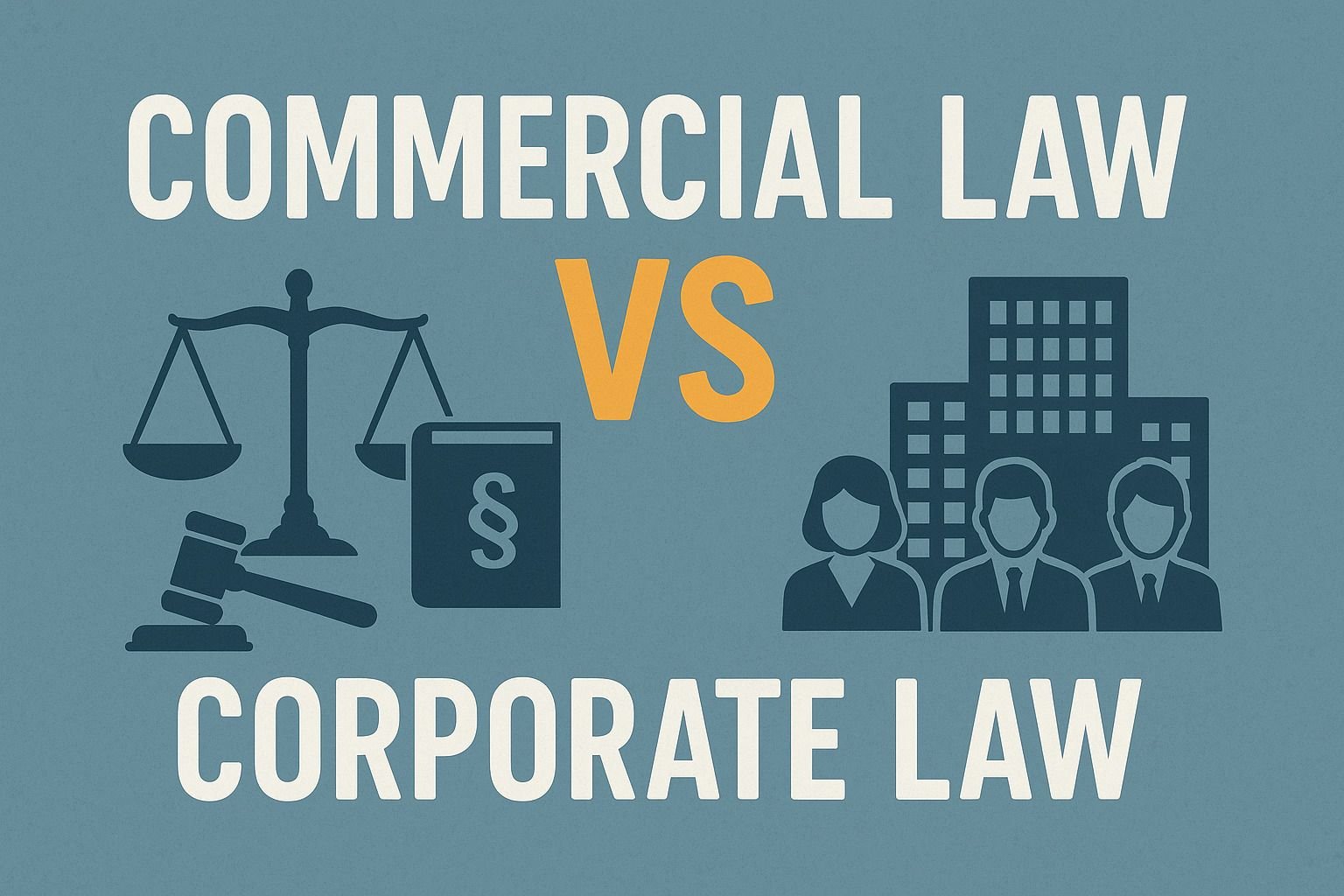
Businesses often use "corporate law" and "commercial law" as if they mean the same thing. They overlap, and many lawyers practise both, but they cover different ground. Corporate law is about the company itself: how it is formed, owned, governed, and wound up. Commercial law is about the transactions a business carries out: buying, selling, lending, shipping, and paying. This guide explains the difference, the main statutes on each side, where the two meet, and how disputes are handled.
The Short Answer
Corporate law governs the entity: its birth, structure, management, funding, and death.
Commercial law governs the activity: the contracts and dealings a business enters into, whether or not it is a company.
A useful test: if the question is "Who controls this company and what must it disclose?", it is a corporate law question. If the question is "Is this contract enforceable and what happens if the buyer doesn't pay?", it is a commercial law question.
What Is Corporate Law?
Corporate law regulates how business entities are created and run. It deals with the relationships between the company, its shareholders, its directors, and the regulators. Its main concerns include:
- Incorporation and structure: Choosing between a private company, public company, One Person Company, or LLP, and preparing the constitutional documents.
- Governance: Duties of directors, board and shareholder meetings, and the protection of minority shareholders.
- Capital raising: Issuing shares, debentures, and convertible instruments, and managing foreign investment.
- Compliance and disclosure: Annual filings, audits, and reporting to the Registrar of Companies.
- Restructuring: Mergers, demergers, acquisitions, and takeovers.
- Exit: Insolvency, liquidation, and striking off.
Key Corporate Law Statutes
- Companies Act, 2013: The central statute on companies.
- Limited Liability Partnership Act, 2008: Governs LLPs.
- SEBI Act, 1992 and SEBI regulations: Cover listed companies, public issues, insider trading, and takeovers.
- Foreign Exchange Management Act, 1999 (FEMA): Controls foreign investment and overseas transactions.
- Competition Act, 2002: Regulates mergers and anti-competitive conduct.
- Insolvency and Bankruptcy Code, 2016: Provides for corporate insolvency resolution.
What Is Commercial Law?
Commercial law, sometimes called business law or mercantile law, governs the day-to-day transactions of trade and commerce. It applies to any business, whether a company, partnership, or sole proprietor. Its main concerns include:
- Contracts: Formation, performance, breach, and remedies.
- Sale of goods: Rights and duties of buyers and sellers, transfer of ownership, and warranties.
- Payment instruments: Cheques, promissory notes, and bills of exchange.
- Consumer dealings: Product liability, unfair trade practices, and consumer remedies.
- Commercial disputes: Litigation, arbitration, and mediation.
- Trade-related areas: Carriage of goods, insurance, agency, and secured lending.
Key Commercial Law Statutes
- Indian Contract Act, 1872: The foundation of commercial law, covering contracts, agency, indemnity, guarantee, and bailment.
- Sale of Goods Act, 1930: Governs contracts for the sale of goods.
- Negotiable Instruments Act, 1881: Covers cheques and similar instruments, including the offence of cheque dishonour under Section 138.
- Indian Partnership Act, 1932: Governs partnership firms, which are based on contract.
- Specific Relief Act, 1963: Provides remedies such as specific performance and injunctions.
- Consumer Protection Act, 2019: Protects consumers against defective goods, deficient services, and unfair practices.
- Arbitration and Conciliation Act, 1996: Governs arbitration of commercial disputes.
- Commercial Courts Act, 2015: Sets up specialised courts and fast-track procedure for commercial disputes.
- Information Technology Act, 2000: Recognises electronic contracts and signatures.
Corporate Law vs Commercial Law: A Comparison
Where the Two Overlap
The line between the two is not sharp. A single business event often involves both.
- Fundraising: Issuing shares to an investor is a corporate matter under the Companies Act and FEMA, but the investment agreement itself is a contract governed by the Indian Contract Act.
- Mergers and acquisitions: Approvals, share transfers, and regulatory filings are corporate, while the purchase agreement, warranties, and indemnities are commercial.
- Director actions: A director signing a contract binds the company under corporate authority rules, but the terms of that contract fall under commercial law.
- Borrowing: Board and shareholder approval for a loan is corporate. The loan agreement, guarantee, and security documents are commercial.
- Insolvency: The IBC deals with corporate insolvency, yet the underlying debt often arises from a commercial contract.
- Competition law: It regulates business conduct in markets, and it affects both mergers and everyday supply arrangements.
Because of this overlap, many law firms treat "corporate and commercial" as a single practice area.
A Worked Example
Consider a startup that manufactures consumer goods.
- Corporate: The founders incorporate a private limited company, agree a shareholders' agreement, appoint directors, and raise a funding round.
- Commercial: The company signs supply contracts with raw material vendors, sells through distributors under a distribution agreement, and accepts payment by cheque.
- Mixed: The board approves a large purchase order, which is a corporate authority question, and the resulting contract is enforced under commercial law.
- Dispute: If a distributor stops paying, the company sends a legal notice, and may file a commercial suit, start arbitration, or pursue a cheque dishonour case. If one founder is sidelined from management, the remedy is a corporate one, such as an oppression and mismanagement petition before the NCLT.
How Disputes Are Resolved
Corporate disputes usually go to specialised tribunals:
- NCLT and NCLAT: Oppression and mismanagement, restructuring, and insolvency.
- Registrar of Companies and adjudicating officers: Compliance defaults and penalties.
- SEBI and the Securities Appellate Tribunal: Securities market violations.
- Civil courts and arbitration: Shareholder and founder disputes that fall outside tribunal jurisdiction, subject to what the law allows.
Commercial disputes are handled through:
- Commercial Courts: Under the Commercial Courts Act, 2015, disputes above a specified value are heard by dedicated commercial courts and High Court divisions. Parties must generally attempt pre-institution mediation before filing, unless urgent interim relief is sought.
- Arbitration: Widely used in contracts, whether domestic or international.
- Consumer commissions: For consumer complaints.
- Criminal courts: For offences such as cheque dishonour under Section 138 of the Negotiable Instruments Act.
Why the Distinction Matters for Your Business
- Choosing the right adviser. A company secretary or corporate lawyer handles governance and filings, while a commercial lawyer drafts and negotiates contracts. Larger deals need both.
- Budgeting for compliance. Corporate compliance is recurring and calendar-driven, while commercial risk arises transaction by transaction.
- Managing liability. Directors face personal exposure under corporate law for breach of duty, while the company faces contractual liability under commercial law.
- Applying the right remedy. Filing in the wrong forum wastes time and money.
- Structuring deals properly. A well-run transaction gets both layers right: valid corporate approvals and enforceable commercial terms.
Common Mistakes Businesses Make
- Treating a signed contract as valid without checking that the signatory had proper authority.
- Raising funds through informal arrangements without complying with share issue rules.
- Relying on oral commercial terms and having no written agreement.
- Ignoring stamp duty on agreements, which can affect admissibility in evidence.
- Using template contracts that do not match the transaction.
- Assuming that a partnership or proprietorship follows company law rules.
- Overlooking limitation periods when pursuing a commercial claim.
Conclusion
Corporate law and commercial law work together but answer different questions. Corporate law shapes the company and the people who own and run it. Parens Patrice Commercial law shapes the deals that company makes every day. A business needs both to be sound: a well-governed structure and well-drafted, enforceable contracts. Understanding where each applies helps you seek the right advice, use the right forum, and avoid gaps that turn into disputes.
This article is for general information and is not legal advice. Statutes, thresholds, and procedures change through amendments and court rulings, so verify current requirements with a qualified lawyer before acting.