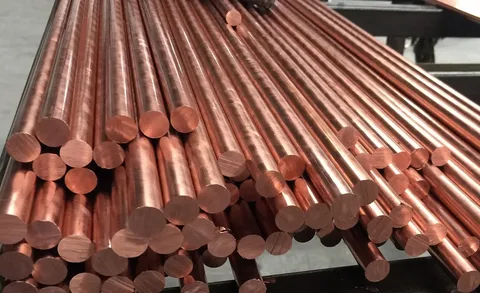
Copper Round Bars start as solid cylindrical stock and finish as valve stems, fitting bodies, heat exchanger headers, electrical connectors, and machined bushings. Fabricators choose them because copper moves heat and electricity better than almost any other engineering metal, resists corrosion in air and water, bends without cracking, and cuts cleanly on a lathe.
Three sectors consume this stock in volume. Plumbing manufacturers turn it into components that touch water. Thermal equipment makers use it where heat must cross a metal wall quickly. Machinery builders specify it for electrical, wear, and fluid handling parts.
What Are Copper Round Bars?
A solid circular cross section, a uniform diameter, and a straight length define copper round bars, and mills produce them by hot rolling, extrusion, or cold drawing. Machinists turn, drill, thread, and mill them into finished parts. Pure grades such as C11000 hold at least 99.9 percent copper and reach 100 percent IACS electrical conductivity.
Copper Alloy Round Bars give up conductivity in exchange for strength, wear resistance, or machinability. Brass adds zinc, bronze adds tin or aluminium, and cupronickel adds nickel. Free cutting brass C36000 machines at a rating of 100, the industry standards, while pure copper rates near 20.
Mills supply diameters from roughly 3 mm to 150 mm, lengths of 3 to 6 metres, and finishes that include bright drawn, peeled, and hot rolled. Required conductivity, strength, corrosion exposure, and the duty of the finished part decide which grade fits.
Key Properties of Copper Metal Round Bars
Copper Metal Round Bars carry heat at about 385 W/m·K, roughly 24 times the rate of 304 stainless steel. Oxygen free and tough pitch grades also reach 100 percent IACS in electrical conductivity, the reference value for that scale. One material therefore serves thermal and electrical designs.
A thin oxide film forms on the surface and slows further attack in air and fresh water, which gives copper its corrosion resistance. Ductility allows fabricators bend, flare, forge, and upset the metal without fracture.
Machinability varies sharply by grade. Tellurium copper C14500 rates 85, and Copper Alloy Round Bars with added lead cut even faster, while pure copper gums tooling unless the operator adjusts speeds and cutting geometry. Brazing, soldering, and forging all suit the metal, copper sheds heat quickly under load, and scrap recycles without losing properties.
Copper Round Bars in Plumbing Applications
Machine shops turn raw bar stock into valve bodies, stems, union and fitting components, connectors, and adapters. They also produce bushings and hardware designed to withstand daily contact with water and moisture. Solid bar stock avoids the porosity risk of castings, so threads and sealing faces machine cleanly.
Engineers who specify copper metal round bars for plumbing parts start with water chemistry. Soft, acidic water corrodes copper faster than neutral hard water, and aggressive supplies can dezincify ordinary brass. Free cutting brass C36000 carries 2.5 to 3.7 percent lead, so potable systems requires low lead alloys that meet NSF/ANSI 372, which caps weighted average lead at 0.25 percent.
Copper Round Bars in Heat Exchangers
Heat exchangers move thermal energy across a metal wall, so the conductivity of that wall sets performance. Copper's 385 W/m·K lets machined headers, end caps, nozzle fittings, and heat sink blocks pass heat with little temperature loss. HVAC coil connections, refrigeration manifolds, and industrial thermal skids use the same machined parts.
Four conditions govern material choice: fluid chemistry, operating temperature, flow velocity, and corrosion exposure. Seawater cooled units requires Copper Alloy Round Bars in grades such as 90/10 cupronickel C70600 or aluminium bronze C63000, because pure copper erodes in fast saline flow. Fast water strips the protective oxide film and starts erosion corrosion, so designers cap velocity and thicken sections at inlets.
Applications of Industrial Copper Round Bars
Industrial Copper Round Bars appear wherever a plant needs conductivity, wear resistance, or both in a solid section. Pump builders machine impeller hubs and shaft sleeves, valve makers produce stems and seats, and electrical contractors cut grounding and connector components from C11000 stock.
Phosphor bronze and leaded bronze bars become bushings and bearings that carry load against steel shafts without seizing. Chromium copper C18200 forms resistance welding electrodes because it keeps its hardness at high temperature while still conducting current. Fastener makers turn bars into terminals, lugs, and bolts for electrical service, and automotive plants use the same stock for tooling and coolant fittings. HVAC and refrigeration plants add compressor fittings and distribution blocks.
Why Choose Corrosion Resistant Copper Bars?
Corrosion resistant copper bars handle atmospheric exposure without a coating, because the surface patina seals the metal beneath. In fresh water and humid air that film holds surface degradation to a slow rate. Properly selected grades keep components in service for decades in plumbing and thermal duty.
Fabrication adds to the case. Suitable grades machine, braze, and form on standard shop equipment, which holds manufacturing cost down. Buyers comparing grades and stock sizes can start with the available Corrosion Resistant Copper Bars.
How to Select the Right Copper Round Bar
Choosing Industrial Copper Round Bars begins with the duty of the finished part, not the catalogue. Define loads, temperatures, and fluids first, then choose the grade or alloy that meets them. Add a machining allowance to the required diameter and length so the part cleans up after turning.
Conductivity and strength pull in opposite directions. Pure grades deliver the highest thermal and electrical values, and every alloying addition lowers them, so most bronze grades conduct under 20 percent of what C11000 does. Strength rises as conductivity falls, which forces a trade that the application must justify.
Corrosion environment narrows the list next. A duty in chloride bearing water requires corrosion resistant copper bars in a cupronickel or aluminium bronze grade, while dry indoor service accepts plain C11000. Check operating temperature, because strength falls as heat rises, then confirm machining requirements and the surface finish the part needs.
Standards and certification close the specification. Name the governing standard, such as ASTM B187 for general purpose rod and bar, ASTM B16 for free cutting brass, EN 12163 for engineering rod, or EN 13601 for electrical use. Request EN 10204 type 3.1 mill certificates so each bar traces to a heat number, and ask suppliers of Industrial Copper Round Bars to confirm chemistry and tolerances.
Conclusion
Copper round bars give plumbing, heat exchanger, and industrial equipment makers one stock form that machines into water contact parts, heat transfer components, and electrical and wear parts. Conductivity, corrosion resistance, machinability, and thermal performance decide which grade fits a given job.
Specify copper metal round bars by grade, diameter, standard, and operating environment, never by price or availability alone. A bar chosen against the real service conditions and backed by a mill certificate performs as designed from commissioning onward.
Tags : Copper Round Bars