The Mould Is Where Production Problems Usually Start
A part can look perfect in CAD and still fail on the shop floor because the Plastic Mould was designed without enough attention to flow, cooling, shrinkage, venting, or ejection. That gap gets expensive fast. One commercial injection-moulding study reduced cycle time from 40 seconds to about 23 seconds after process optimisation. Which means a few seconds saved per shot can matter across a long production run.
Most buyers make the mistake of treating the mould as a one-time tooling purchase. It actually controls repeatability, rejection, cycle time, finish, and how much operator intervention production will need.
The Spec Detail Most Buyers Skip
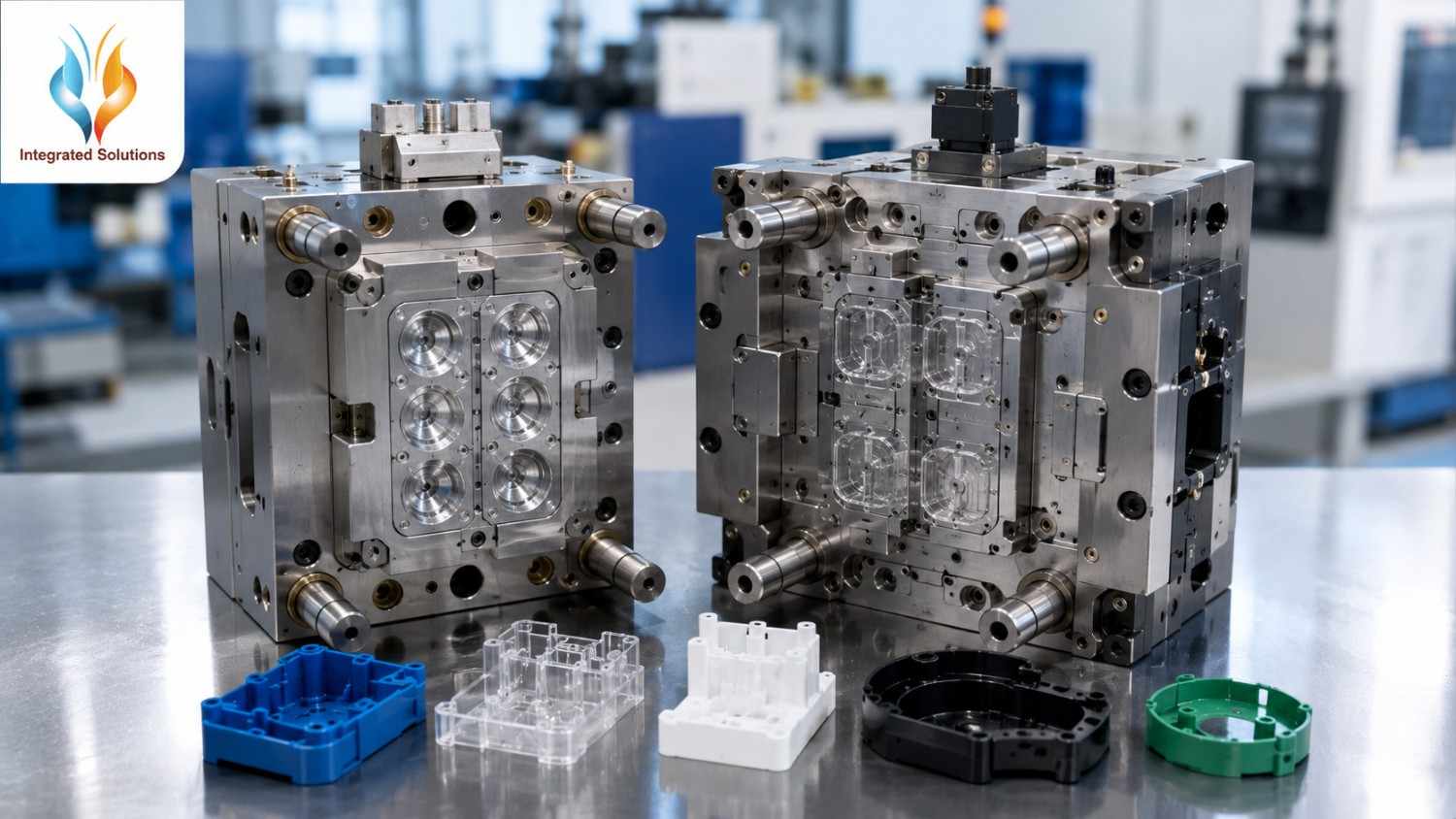
Core, Cavity, Cooling and Ejection
Industrial moulds may use single or multiple cavities depending on part geometry, output requirements, material behaviour, and production economics. Core and cavity material, cooling channels, ejector position, venting, runner and gate design, surface finish, and shrinkage allowance all matter.
Here is the overlooked detail: draft. Protolabs advises at least 0.5° draft on vertical faces, while 1–2° works well in many moulding situations. BASF also notes that shrinkage changes with wall thickness, gate design, injection pressure, holding pressure, mould temperature, and material grade. A supplier who asks only for a 3D file before quoting is not doing enough engineering.
Five Questions That Expose a Weak Supplier
Five Checks Before You Approve Tooling
- Inputs: Expect questions about resin, volume, tolerances, finish, assembly, and machine details. A bad answer is: “Send CAD; we’ll manage.”
- Flow and warpage: Autodesk Moldflow evaluates material flow, cooling, and warpage. “We made something similar before” is not a technical review.
- Wall and rib design: Protolabs recommends ribs around 40–60% of the adjacent wall thickness to help reduce sink and stress. “We use one standard for every part” is a warning sign.
- Trial validation: Ask for trial parts, dimensional checks, defect review, and agreed acceptance points. A dispatch date without sample criteria is incomplete.
- Corrections: Get responsibility in writing. “We handle defects case by case” means the difficult negotiation starts after you have already paid.
Where Better Mould Engineering Protects Margin
Six Commercial Gains
A well-engineered Plastic Mould can reduce rejection, stabilise dimensions, shorten cycles, cut trimming, improve tool life, and make scale-up more predictable.
Cooling deserves special attention. A 2025 industrial case study using conformal cooling reported a 66% reduction in cycle time and a 90.5% reduction in warpage. Not every mould will reach those numbers, but poor cooling design can quietly consume margin on every shot.
And yet, buyers still approve tools mainly on purchase price. Saving on steel or engineering is meaningless if the resulting tool adds scrap, rework, or seconds to every production cycle.
Gurugram Is a Supply-Chain Decision
Buyers comparing Plastic Mould manufacturers in India should consider correction cycles as well as freight. Integrated Solutions lists its facility at Khasra No. 55, 108, Dhankot Flyover, Basai, Sector 9B, Gurugram, Haryana 122006, and its website states that enquiry callbacks are handled within 24 hours.
That matters because mould development often requires physical trials, measurement feedback, tool corrections, and another trial before sign-off.
We Keep Design and Tool Development Connected
At Integrated Solutions, we work across product design, tool development, CNC and VMC machining, mould manufacturing, plastic-part production, reverse engineering, and mould-flow analysis. Our published mould-development workflow covers five stages: requirement analysis, CAD-based development, material selection, prototype testing, and final mould manufacturing.
We know the harder job is not machining one accurate cavity. It is carrying the same tolerance intent from drawing to tool trial without losing it between design, machining, inspection, and correction.
At Integrated Solutions, we need your 2D/3D drawing, resin grade, target quantity, tolerance sheet, finish requirement, machine details, and sample photographs where available. We state a response window of within 24 hours for enquiries.
Our MOQ is project-dependent, not a fixed number. Share your expected monthly or annual volume so we can recommend prototype tooling, production tooling, or a staged development route.
Conclusion
A Plastic Mould should be judged by the parts it repeats, not by how polished it looks at dispatch. Even draft commonly starts around 0.5–2°, depending on geometry and surface requirements; small design choices have production consequences. Define cooling, shrinkage, venting, gating, validation, and correction responsibility before ordering, and the next production ramp becomes easier to control.
FAQs
1. What is a Plastic Mould used for?
It shapes plastic into repeatable components. Tool design depends on resin, geometry, tolerances, cavity count, surface finish, and expected production volume.
2. How should I compare mould suppliers?
Good Plastic Mould manufacturers should show design-review, machining, mould-flow, trial, inspection, correction, and maintenance capabilities. Price alone does not reveal actual production cost.
3. What information is needed for a quotation?
Most Plastic Mould manufacturers in India need drawings, resin grade, target volume, tolerances, finish, sample images, and machine constraints. If resin is undecided, say so before design starts.
4. Is 1° draft enough for every plastic part?
No. Protolabs suggests 0.5° minimum on vertical faces and 1–2° for many cases, but texture, depth, resin, and geometry may require more.
5. Does mould-flow analysis eliminate defects?
No. It predicts flow, cooling, and warpage tendencies, but results depend on accurate inputs and realistic conditions. Physical tool trials are still necessary.
6. How quickly does Integrated Solutions respond?
Our website states that enquiry callbacks are handled within 24 hours. Final pricing can still require drawings, resin details, tolerances, quantity, and critical-dimension clarification.
7. Is MOQ fixed for custom mould projects?
Not always. MOQ depends on cavity count, validation scope, material, and production economics. For custom tooling, realistic project volume matters more than a universal minimum.