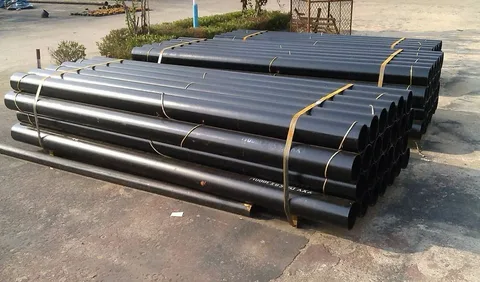
Carbon steel pipes transport fluids, gases, and raw materials across global infrastructure. The base metal provides massive physical strength. This raw durability keeps heavy piping systems operational for decades. Projects demanding absolute structural integrity rely on high-strength carbon steel pipes to prevent catastrophic failures under extreme mechanical stress.
What Are Carbon Steel Pipes?
Iron and carbon make up the primary composition of carbon steel. The carbon itself acts as the main hardening agent. Increasing the carbon percentage immediately raises the material's yield strength and surface hardness.
Unlike stainless variants, these materials lack expensive chromium additions. Keeping those costly elements out keeps overall project budgets low. Oil refineries and power plants utilize them daily. They function perfectly in environments where engineers need structural rigidity.
Types of Carbon Steel Pipes
Carbon Steel Seamless Pipes: Extrusion processes create Carbon Steel Seamless Pipes without forming a longitudinal weld seam. The resulting solid steel wall withstands massive internal pressure spikes. High temperatures do not degrade the structural integrity. Offshore platforms and process networks depend on this seamless construction.
Carbon Steel Welded Pipes: Forming flat steel coils into cylinders creates Carbon Steel Welded Pipes. Fabricators join the edges securely. This approach allows production in massive diameters. Overall manufacturing costs drop significantly. Structural supports and low-pressure municipal water mains rely on these specific variants.
ERW Carbon Steel Pipes: High-frequency current fuses the steel edges during Electric Resistance Welding. The mill adds no filler metal. Projects favor ERW products for standard fluid transmission.
LSAW Carbon Steel Pipes: When working with thick plates, operators utilize Longitudinal Submerged Arc Welding. The welding arc operates entirely under a layer of granular flux. Pipeline operators select LSAW for high-pressure transmission networks.
SSAW Carbon Steel Pipes: Coiling the steel plate into a spiral shape produces Spiral Submerged Arc Welded pipes. Water transport projects consume large quantities of SSAW products.
Common Carbon Steel Pipe Grades: Defining the exact material grade requires evaluating project parameters. You cannot simply select the strongest metal available.
ASTM A106 specifies seamless material strictly for high-temperature service. ASTM A53 covers both seamless and welded options for standard mechanical applications. API 5L determines line pipe for petroleum transport networks. ASTM A333 mandates rigorous impact testing for freezing environments. ASTM A179 applies directly to heat exchangers.
System designers evaluate internal pressure ratings, thermal extremes, and fluid properties before authorizing purchases.
Key Properties of Carbon Steel Pipes
High Strength: Immense internal pressure requires tough materials. Thick walls stop mechanical deformation completely.
Durability: Harsh environments demand heavy structures. Raw material density resists direct physical impacts on active construction sites.
Good Weldability: The exact carbon equivalent completely changes fabrication difficulty. Low-carbon variants weld easily using standard techniques. High-carbon versions demand immediate pre-heating and strict temperature controls during joining operations.
Good Machinability and Fabrication: Contractors cut, bend, and thread these metals using standard equipment. The metal responds predictably to cold bending processes.
Cost-Effectiveness: Strict budget limitations force project managers to choose Industrial Carbon Steel Pipes. The material delivers massive structural value per dollar spent.
Wide Size and Thickness Availability Mills supply outside diameters from half an inch to several feet. Wall thicknesses scale up to handle extreme industrial requirements.
Carbon Steel Pipe Manufacturing Process: Multiple precise mechanical stages define the production cycle. Foundries first melt raw iron and cast it into solid steel billets or flat plates.
Creating seamless products involves pushing a heavy mandrel directly through a red-hot solid billet. Welded production requires rolling machines to bend flat plates into cylinders before welders fuse the seams.
Heat treatment normalizes the internal grain structure. Sizing rollers compress the metal to meet exact dimensional tolerances. Technicians then apply surface treatments like galvanizing or protective oil coatings. Quality control teams execute hydrostatic testing and ultrasonic inspections.
Applications of Carbon Steel Pipes
Distinct mechanical reasons drive consumption across different sectors.
Oil and Gas operators transport raw crude under pressure. Power facilities move steam through boiler networks. Water authorities build underground distribution mains. Construction firms erect building frameworks. Chemical plants transfer fluids between reactor vessels. Manufacturing facilities build equipment frames.
How to Choose the Right Carbon Steel Pipe
- Identify the Application: Determine exactly what fluid or gas the system will transport daily.
- Check Operating Pressure: Calculate the maximum internal pressure the piping will experience.
- Consider Operating Temperature: Extreme temperatures define specific material grades.
- Select Seamless or Welded Construction: Match the manufacturing method to your precise structural requirements.
- Choose the Correct Grade and Standard: Reference ASME or API codes to find the exact material specification.
- Consider Corrosion Protection: Specify protective linings if moisture exposure exists.
- Verify Testing and Certification: Demand physical mill test reports confirming chemical composition.
Conclusion
Modern industrial infrastructure relies heavily on carbon steel piping. Choosing between seamless and welded variations depends entirely on the mechanical purpose. Their inherent strength keeps project costs manageable over long periods. Engineers must evaluate exact grades, dimensions, and manufacturing methods before approving any purchase order.
Tags : Carbon Steel Pipes