A U.S. degree has traditionally offered international students two potential returns: an academic qualification and the chance to gain professional experience after graduation. A reported $100,000 charge for Optional Practical Training could put that second benefit under a very different financial calculation.
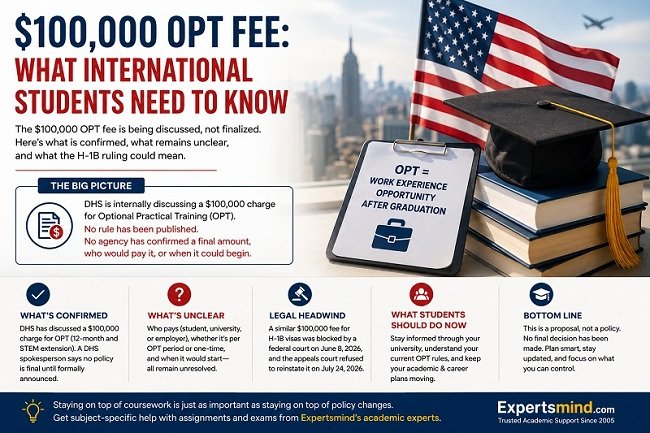
But there is an important distinction to make before drawing conclusions. The research paper says the Department of Homeland Security (DHS) has discussed a possible $100,000 OPT charge, but no final policy has been published. There is no confirmed start date, official payment structure or final decision on who would pay.
For students considering the United States, the story is therefore less about an immediate $100,000 bill and more about the uncertainty surrounding the future of post-study work.
OPT Has Become Part of the Study-Abroad Equation
Optional Practical Training allows eligible F-1 students to work in the United States after completing their degree. Standard OPT can last up to 12 months, while eligible STEM graduates may receive a further 24-month extension.
For many students, that period is an important part of the decision to study in America. A graduate can use the time to gain practical experience, earn an income and potentially pursue longer-term employment opportunities.
The financial calculation becomes clearer when viewed over several years. A student may spend a substantial amount on tuition and living costs before graduating. The ability to work afterward can help offset that investment.
A six-figure charge could change the equation.
It would be like buying a car because you can afford the monthly payments, only to discover after purchase that using it for work requires another major fee. The original price has not changed, but the value of the entire decision has.
Students exploring U.S. degree options can review available subjects and academic pathways through Expertsmind.com's U.S. study-subject resources as part of that broader planning process.
The Proposal Still Has Major Gaps
The biggest mistake students can make right now is treating the reported figure as a complete policy.
It is not.
The research paper identifies several major questions that remain unanswered. The first concerns who would pay the proposed fee. It could potentially fall on the student, university or employer, and each option would create a different financial impact.
The structure is also unclear. It has not been established whether the charge would apply to the initial OPT period, a STEM extension, each period separately or as a single payment.
Then there is timing. DHS is reportedly considering a broader overhaul of OPT rules, potentially later in 2026, but the paper makes clear that this timeline has not been confirmed.
These gaps matter because policy headlines can make an uncertain proposal appear much more settled than it is.
There is currently no published regulation requiring international students to pay $100,000 for OPT. Students should therefore avoid changing enrollment plans or abandoning applications solely because of the reported proposal.
At the same time, ignoring the report completely would also be unwise. Students making decisions several years ahead should understand that immigration rules can change during the life of a degree.
The H-1B Fee Fight Raises Legal Questions
The proposed OPT fee also comes against the backdrop of a similar dispute involving H-1B visas.
According to the research paper, a $100,000 fee was attached to certain new H-1B petitions in September 2025. Twenty states challenged the measure, arguing that the executive branch lacked clear statutory authority to impose such a large charge.
A federal judge in Massachusetts vacated the policy in June 2026. The government appealed and asked the First Circuit to pause the ruling.
On July 24, the First Circuit declined to do so. The court did not make a final ruling on the underlying merits, but the decision left the H-1B fee blocked nationwide while the wider legal dispute continued.
That does not automatically invalidate a future OPT fee. An OPT rule could have a different legal structure.
Still, the H-1B case demonstrates that a six-figure immigration fee can face substantial legal challenges. If DHS eventually publishes an OPT proposal, its legal authority will likely become an important part of the debate.
Students Should Plan Around Facts, Not Headlines
The current uncertainty makes disciplined planning more valuable.
Students already in the United States should monitor communications from their international student offices and consult their designated school officials about questions involving their individual OPT timelines.
Prospective students should compare the full cost of a U.S. education, including tuition, accommodation, living expenses and the possibility of changing immigration rules.
They should also keep academic progress separate from policy anxiety. A student who is distracted by every new immigration headline can quickly fall behind on assignments, projects and examinations.
For students who need additional support managing coursework, Expertsmind.com's homework help resources can be useful alongside their normal university resources.
The goal is not to predict exactly what DHS will do. The goal is to remain prepared if the rules change.
The Real Issue Is Predictability
The proposed fee highlights a larger question facing international education: how much uncertainty are students willing to accept when choosing a destination?
Students do not evaluate universities in isolation. They look at the entire journey from admission to graduation and, often, employment.
That makes post-study work rules part of the value of an international degree. If those rules become harder to predict, students may begin giving greater weight to destinations where the pathway feels more stable.
The United States remains a major destination for international education, but uncertainty can influence future choices. Canada, the UK and Australia may benefit when students start comparing not only academic quality but also the reliability of post-graduation opportunities.
For now, the reported $100,000 OPT fee remains a proposal under discussion, not a confirmed requirement. Students should keep that distinction firmly in mind.
The best response is neither panic nor complacency. Follow official updates, understand the rules that actually apply today, keep academic plans moving and consider the financial risks of any study-abroad decision.
A headline can change overnight. A degree can shape the next decade. Students should make the latter decision using verified facts, not the former.