Introduction
With the rapid growth of communication and networking technology, reliable and affordable connectivity has become essential for homes, offices, schools, and businesses. Cat5 cables have been widely used for Ethernet and network connections because of their simple installation, compatibility, and cost-effectiveness.
Although newer standards such as Cat5e, Cat6, and Cat7 offer higher performance, Cat5 cables can still be useful for basic networking requirements. In India, they remain a practical option for users who need reliable connectivity without investing in advanced networking infrastructure.
What Are Cat5 Cables?
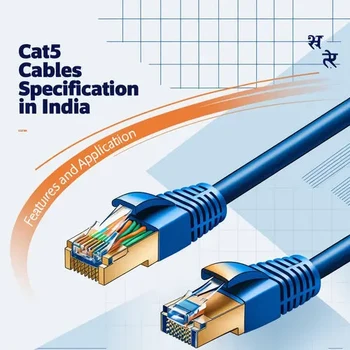
Category 5 (Cat5) cables are twisted-pair network cables designed to transmit data for Ethernet and other communication applications. They typically contain four twisted pairs of copper conductors, with the twisting helping reduce interference and maintain signal quality.
A standard Cat5 Ethernet cable can support speeds of up to 100 Mbps and network distances of up to 100 meters (328 feet) under appropriate conditions. Their RJ45 connectors make them compatible with many routers, switches, computers, and other Ethernet-enabled devices.
Key Features of Cat5 Cables
1. Data Transfer Speed
Cat5 cables support data speeds of up to 100 Mbps, making them suitable for basic internet access, web browsing, email, file sharing, and other everyday networking activities.
For applications that require Gigabit Ethernet or higher speeds, newer cable categories such as Cat5e and Cat6 are generally more suitable.
2. Twisted-Pair Construction
Cat5 cables use pairs of twisted copper wires. This construction helps minimize electromagnetic interference and crosstalk between wire pairs, allowing data to travel more reliably across the network.
3. Up to 100-Meter Network Distance
A standard Ethernet channel can support a total distance of up to 100 meters, including the permanent link and patch cables. Staying within the recommended distance helps maintain network performance and signal quality.
4. RJ45 Connectivity
Cat5 Ethernet cables commonly use RJ45 connectors, making them compatible with a wide range of networking devices, including routers, switches, PCs, network printers, and other Ethernet devices.
5. Easy Installation
Cat5 cables are relatively lightweight and flexible, making them convenient for routing through offices, homes, classrooms, and other indoor networking environments.
Technical Specifications of Cat5 Cables
Understanding the basic specifications of Cat5 cables can help you determine whether they are suitable for your networking requirements.
Bandwidth
Cat5 cabling is commonly associated with a bandwidth of up to 100 MHz. The actual network speed depends on the Ethernet standard, connected devices, installation quality, and other network components.
Cable Length
For standard Ethernet networks, the recommended maximum channel length is 100 meters. Using cables beyond the recommended distance can result in signal degradation or connectivity issues.
Cable Construction
Cat5 cables generally contain four twisted pairs of copper conductors covered by an insulating layer and an outer protective jacket. Cable construction can vary depending on the manufacturer and specific product.
Shielding
Many Cat5 cables use Unshielded Twisted Pair (UTP) construction. Shielded versions are also available for environments where additional protection against electromagnetic interference is required.
Applications of Cat5 Cables in India
Cat5 cables can be used for several basic networking and communication applications.
1. Home Networking
Cat5 cables can connect devices such as computers, routers, switches, and other Ethernet-enabled equipment in homes. They can be used for internet access, file sharing, local networking, and other everyday activities.
2. Office and Small Business Networks
Small offices and businesses can use Cat5 cables to connect computers, printers, routers, switches, and other network devices. They can be a cost-effective option when network requirements do not demand higher-speed Ethernet standards.
3. Telephone and VoIP Systems
Twisted-pair cabling can also be used in certain telephone and VoIP networking installations. Businesses can use suitable network infrastructure to support voice communication alongside their data requirements.
4. CCTV and Security Systems
Ethernet cabling is commonly used in network-based surveillance setups. Depending on the equipment and installation requirements, suitable Cat-rated cables can connect IP cameras and networking devices.
5. Schools and Educational Institutions
Schools, colleges, and training centres can use Ethernet cabling to connect computers, printers, switches, and other network equipment. Cat5 can be considered for basic networking environments where higher bandwidth is not required.
6. Small Networking Projects
Cat5 cables can also be useful for basic LAN installations, device-to-device connections, and other networking projects where cost and compatibility are important considerations.
Advantages of Cat5 Cables
Cat5 cables continue to have several advantages for basic networking applications:
- Cost-effective networking solution
- Easy to install and manage
- Compatible with standard RJ45 Ethernet connections
- Suitable for basic Ethernet networking
- Available in different lengths
- Useful for homes, offices, and educational environments
- Twisted-pair construction helps reduce interference
Cat5 vs Newer Ethernet Cable Categories
As networking requirements increase, users may consider Cat5e, Cat6, Cat6A, or higher categories.
Cat5 is generally suitable for basic networking requirements, while Cat5e and Cat6 cables are better choices for modern networks that require higher speeds and greater performance.
Before selecting a cable, consider your internet speed, networking equipment, required distance, installation environment, and future upgrade requirements.
How to Choose a Cat5 Cable?
When buying a Cat5 cable in India, consider the following factors:
Check the Required Length
Choose a cable length that is sufficient for your setup without leaving excessive cable that can create clutter.
Check Connector Quality
Look for properly constructed RJ45 connectors that provide a secure connection with your networking devices.
Consider Cable Construction
Choose a cable with suitable construction and jacket quality based on whether it will be installed in a home, office, or other environment.
Consider Your Network Requirements
If your network requires Gigabit Ethernet or higher speeds, consider whether Cat5e or Cat6 would be a better long-term option.
Future of Cat5 Cables in India
Networking technology continues to evolve, with fibre-optic connections and higher-category Ethernet cables becoming increasingly common. As bandwidth requirements increase, Cat5 may become less suitable for new high-performance network installations.
However, its affordability, availability, and compatibility mean that Cat5 can still have a place in basic networks, legacy systems, small installations, and applications where higher speeds are not necessary.
Conclusion
Cat5 cables remain a practical networking option for basic connectivity requirements. Their affordability, simple installation, RJ45 compatibility, and reliable performance make them suitable for homes, small offices, educational institutions, and other basic networking environments.
While newer cable categories such as Cat5e and Cat6 offer greater performance for modern high-speed networks, Cat5 can still be considered when the networking requirements are modest and cost-effectiveness is important.
Choosing the right Ethernet cable ultimately depends on your required speed, distance, network equipment, installation environment, and future upgrade plans.
Frequently Asked Questions
What is a Cat5 cable?
A Cat5 cable is a twisted-pair Ethernet cable designed for transmitting data over wired networks.
What speed does Cat5 support?
Cat5 is commonly used for Ethernet speeds up to 100 Mbps.
What is the maximum length of a Cat5 Ethernet cable?
A standard Ethernet channel is designed for a maximum distance of up to 100 meters.
Does Cat5 cable use an RJ45 connector?
Yes, Cat5 Ethernet cables commonly use RJ45 connectors for connecting network devices.
Is Cat5 still useful?
Yes. Cat5 can still be useful for basic networking applications where higher Ethernet speeds are not required.
Should I buy Cat5 or Cat6?
For basic networking, Cat5 may be sufficient. For modern high-speed networks and future upgrades, Cat6 can be a more suitable choice.