Beyond Broken Links: What KWT Spider and Screaming Frog Reveal About Your Site’s AI Readiness
By kwt spider 30-09-2026 25
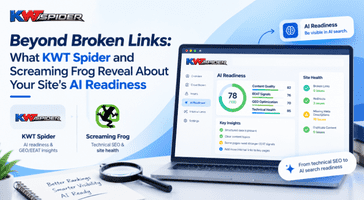
For years, a website crawl was mostly about finding things that were broken. You checked for 404 pages, redirect chains, duplicate titles, missing meta descriptions, canonical problems, blocked resources, and pages that search engines could not reach. Those checks are still important. A technically broken website is not going to become healthy simply because search has changed. But search has changed. People increasingly discover information through AI-generated answers, search summaries, conversational assistants, and other interfaces that do not always behave like a traditional list of ten blue links.
That leads to a bigger question for SEO teams: Is a website only technically healthy, or is it organized in a way that modern search and artificial intelligence systems can understand?
That’s where the difference between traditional and newer methods of crawling becomes interesting. Tools like Screaming Frog have made technical crawling a standard part of SEO workflows. Newer crawlers such as KWT Spider are beginning to focus more on areas like generative search readiness, content signals, and local analysis. This is not to say that AI optimization is a replacement for technical SEO. It is a look at the both.
Technical SEO Still Prevails
Before we get into AI search, it’s worth stating an obvious point: the basics have not gone away. You should still be able to answer questions like:
- Which URLs are returning 4xx or 5xx responses?
- Are redirects properly set up?
- Are important pages properly canonicalized?
- Are internal links linking to the right places?
- Are pages missing key metadata?
- Is the content accessible to search engine crawlers?
- Do we have orphaned or poorly linked pages?
- Are you creating unnecessary crawl complexity with large URL counts?
This is one of the few areas where established crawlers are still quite useful. Screaming Frog SEO Spider is a commonly utilized tool for deep technical crawling. It has a lot of options for configuration and extraction. That depth can be especially useful for advanced SEO teams investigating complex sites. KWT Spider takes a somewhat different approach to the same general problem of combining traditional crawling with additional analysis for newer search workflows. This distinction is important because you still need a technically sound website, even if it is AI-readable.
The New Question: Do Machines Understand What They Read?
A search engine needed to find and index a page traditionally. AI-powered search also provides another level. Systems that generate answers may have to find the most relevant pieces of information, relations between entities and topics, interpret the structure of the page, and decide whether information appears trustworthy and useful enough to reference. That is not to say there is a single technical checklist that will guaranty inclusion in an AI answer. There is not. Artificial intelligence systems are complex and it’s not always clear how they discover and attribute information. But websites can still leak useful signals. Clear headings, logical content structures, descriptive links, accessible text, appropriate structured data, author and organization info and strong topical consistency can all help make a site easier for machines to interpret. That’s where an AI-era crawler can go beyond the traditional “is this URL working?” question.
What a Normal Crawl Can Teach You
Imagine crawling a 10,000 page website with a standard technical SEO crawler. You might find that:
- 340 URLs are erroring out.
- 1,200 pages have identical or nearly identical titles
- 600 pages with redirect chains
- A few important sections lack strong internal linking
- canonical data are missing for hundreds of URLs;
- Some resources are blocked from being crawled
This is a very valuable information. It gives you an idea of where the technical architecture of the site needs work. But that doesn’t necessarily speak to whether the content on the site is structured in a way that’s going to work well for emerging AI-search experiences. For example, two websites could have very similar technical health scores but present their information very differently. Answers might have been well organized and clearly structured, with identifiable entities, supporting evidence, consistent terminology, and topical sections. The other might hide important information in poorly structured pages. And both could look pretty healthy from a conventional crawl perspective. There may be more to investigate from an AI-readability perspective.
KWT Spider Adds a Different Layer
This is one of the differentiating factors of KWT Spider. In addition to the standard technical SEO analysis, KWT Spider also has GEO (Generative Engine Optimization) related features and EEAT signals. The point isn’t that a crawler will know exactly what ChatGPT, Gemini, Google AI Overviews or another system will decide to cite. Instead, the analysis provides an additional way to verify whether a web site provides information in a way that is machine-understandable and well-structured. This can make the crawl more useful than just looking at response codes and metadata for teams experimenting with AI-search optimization. It turns the crawl into a more general diagnostic exercise:
What is technically wrong with this website, and what could make its information easier for modern search systems to interpret?
These are different questions, but they can be investigated in the same workflow.
GEO Isn’t an Alternative to SEO
This is a significant difference. GEO should not be seen as a magic layer that replaces conventional SEO. Adding AI-focused recommendations alone is unlikely to help a page with broken links, inaccessible content, poor architecture or serious indexing issues. Instead, GEO can be viewed as another input to an ever more complex search environment.
The classic SEO question:
Can search engines find, crawl, understand and index this page?
Questions like:
Is the information structured and clear enough for systems that generate answers from multiple sources?
The two overlap. That overlap is why a mix of technical crawling, newer content and AI-readiness checks can be useful.
A Crawl Can Also Be About What Hasn’t Been Published Yet
Another interesting difference appears when you get away from live websites. Most crawling workflows assume by default that there is a website to crawl. However, SEO teams and developers should check out a site before it launches. KWT Spider also has an Offline Mode, which allows you to analyze local website files. For example, a developer might have a folder of HTML, PHP or ASP files and want to check the site structure before deploying. An offline crawl can be useful for finding problems with links and assets before publishing the site to find just basic problems. This results in a slightly different workflow:
Build → crawl locally → identify problems → fix → deploy.
It doesn’t have to be AI search, which can be useful for dev teams. It also makes a good point about desktop crawlers – not every useful crawl needs to begin in the public domain.
Spider Mode, URL Lists, Targeted Checks
Another practical consideration is that SEO audits don’t always need a full website crawl. Sometimes you have a list of URLs that come from a migration. Sometimes you want to get into a certain set of pages. Sometimes you just want to check a single URL. KWT Spider has multiple workflows: Spider Mode, URL List Mode and Offline Mode. It also offers individual utilities e.g. URL auditing, redirects, robots testing, sitemap testing and GEO related analysis.
This workflow can be helpful when the question is more limited than:
"Crawl my entire website."
For instance:
"How are these 150 migrated URLs performing?”
or
“What does this landing page look like from a technical and AI-readiness perspective?”
Those checks can be less cumbersome with smaller diagnostic tools alongside a full crawler.
Screaming Frog and KWT Spider Aren’t Solving the Same Problem
It’s tempting to make the comparison of crawlers just a simple “Tool A vs. Tool B” discussion. That often misses the point. Screaming Frog is a veteran in technical SEO and is known for deep crawling, detailed configuration, custom extraction, JavaScript rendering and large scale auditing workflows. KWT Spider is a relatively new desktop crawler that combines traditional technical SEO crawling with features targeting areas that have recently become more visible in SEO discussions, such as GEO analysis and offline website inspection.
So the question is not necessarily:
Which crawler is better?
It is:
What do you want your crawler to tell you?
If the depth of a mature crawler matters for a highly configurable technical investigation, your main need is
If you also have AI-search analysis, local website testing and a more consolidated interface for technical and newer search-related checks in your workflow, then a tool such as KWT Spider may be worth a try alongside the established options. Those are workflow differences, not an all-around winner.”
What an AI Website Audit Would Look Like
A modern crawl might then have multiple layers.
Level 1: Technical wellness
Check:
- status code
- re-directs
- broken links
- canonicalisation
- robots directives;
- XML sitemap
- meta data
- links within the website
- crawlability
Layer 2: Structure of content
Check:
- hierarchy of subheadings
- structuring of content
- placement of important information
- duplicate/thin content
- internal links for context
- relationships between entities and topics
Layer 3: Flow of information and trust
Check:
- author info
- Information on the organization
- citations for support
- coherence of statement
- clarity
- structured data where applicable
Layer 4: AI search considerations
Search:
- GEO signals
- generative querying content organization
- data in a machine readable format
- Recommendations for AI
- Resources like llms.txt where appropriate for the site's strategy
None of this is a layer that ensures visibility in an AI-generated answer. This is an important caveat. Artificial intelligence systems can change their retrieval, ranking signals, models, citation behavior with no warning. Even a page that is highly technically meritorious may still be absent from a particular AI answer. So the goal is not to “optimize for guaranteed citation.” It is to make the information on site technically accessible, clearly structured and easier for different kinds of search systems to interpret.
The Crawler Is Growing Beyond a Broken-Link Finder
This could be the biggest shift in how SEO crawling is evolving. The traditional crawler was primarily an inspection device. You crawled the site, downloaded the data, found problems and corrected them. That workflow is still there. But as search becomes more conversational and more oriented toward answers, the questions being posed to crawlers are becoming broader.
Rather than just asking:
- What pages are broken?
SEO teams may ask more and more often:
- Which pages are difficult for machines to read?
- What is poorly arranged important information?
- What content needs to be clarified?
- Are the main entities and relationships clear?
- Is the website preparing for the search experience beyond returning a list of URLs?
Tools will answer these questions differently.
Conclusion
Screaming Frog is still very useful for deep technical investigation. KWT Spider is a newer methodology, combining the traditional crawling base with features suited to the changing search environment. Neither negates the other. In fact, the most useful SEO workflow may simply be one that recognizes that technical SEO and AI-search readiness are becoming more and more connected. The foundation is still a healthy website. But in a search landscape shaped by AI, knowing what a website says — and how clearly it says it to machines — is becoming part of the audit too.