B2B Marketing Automation: How to Generate Better Leads Without Expanding Your Team
By Stella Morgan 25-09-2026 5
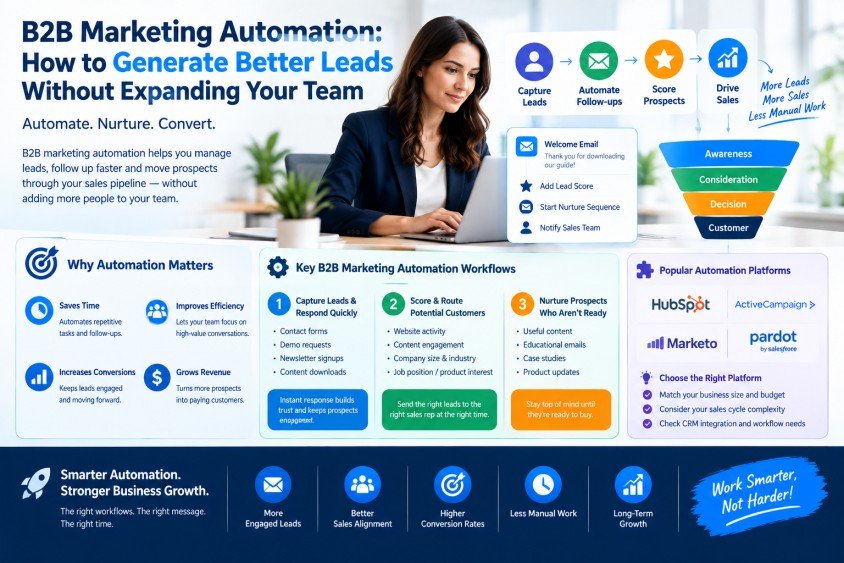
For many B2B businesses, the challenge isn't attracting potential customers—it's managing every interaction after someone shows interest. A prospect may download a resource, request information, or visit a pricing page, but without timely follow-up, that opportunity can quickly disappear.
B2B marketing automation helps companies manage these repetitive activities without adding more people to the team. Instead of relying on spreadsheets, reminders, and manually triggered emails, businesses can create workflows that respond to customer actions automatically.
The goal isn't to remove human involvement from marketing and sales. It's to reduce repetitive work so teams can spend more time on qualified prospects, meaningful conversations, and revenue-generating activities.
Understanding B2B Marketing Automation
B2B marketing automation refers to technology that automates recurring marketing activities according to predefined rules and customer behavior. These activities can include email campaigns, lead scoring, follow-ups, audience segmentation, social media publishing, and retargeting.
For example, when someone downloads a whitepaper, an automated workflow can send a confirmation email immediately, assign a lead score, and enroll that person in a relevant follow-up sequence.
However, automation alone doesn't create an effective marketing strategy. Businesses still need clear messaging, accurate targeting, useful content, and a well-defined customer journey. Automation simply makes it easier to execute that strategy consistently.
Popular platforms such as HubSpot, ActiveCampaign, Marketo, and Pardot offer different levels of automation. The appropriate choice depends on factors such as company size, budget, sales-cycle complexity, CRM requirements, and the number of workflows the marketing team needs to manage.
Connecting Marketing Automation With the Sales Pipeline
Marketing automation and sales processes work best when they are connected rather than treated as completely separate systems.
Marketing automation generally focuses on attracting prospects, collecting information, segmenting audiences, and nurturing people who aren't ready to purchase. Once a prospect demonstrates stronger buying intent, automated sales workflows can help move that opportunity toward the appropriate sales representative.
For instance, imagine a prospect downloads a product comparison guide. The marketing system can record the interaction, assign a score, and place the prospect into a relevant email sequence. If that person later returns to the pricing page several times, the system can recognize the increased engagement.
At that point, a Sales funnel workflow can help route the opportunity to the appropriate salesperson, trigger a follow-up task, update the CRM stage, or send a meeting invitation.
This connection reduces the amount of manual coordination required between marketing and sales. More importantly, it helps ensure that promising prospects don't remain unnoticed simply because someone failed to follow up.
Three Marketing Workflows to Build Before Anything Else
Businesses often make the mistake of trying to automate their entire customer journey immediately. A better approach is to begin with a few high-impact workflows and improve them before introducing more complexity.
1. Capture Leads and Respond Quickly
Every meaningful conversion point should have an appropriate follow-up process. This can include contact forms, demo requests, newsletter registrations, webinar signups, and content downloads.
Instead of making prospects wait for someone to respond manually, an automated workflow can acknowledge their request immediately and deliver the next relevant resource.
The first message doesn't need to make a hard sales pitch. Its purpose can simply be to confirm the action, provide useful information, and establish the next step.
2. Score and Route Potential Customers
Not every lead deserves the same level of sales attention. Lead scoring can help teams distinguish casual visitors from prospects showing stronger purchase intent.
Scoring criteria can include:
- Website activity
- Content downloads
- Email engagement
- Company size
- Industry
- Job position
- Product interest
- Demo or pricing-page visits
Once a prospect reaches a predefined threshold, the automation platform can notify or assign the lead to the appropriate salesperson.
3. Nurture Prospects Who Aren't Ready
Many B2B buyers need considerable time to evaluate their options. Sending every new lead directly to sales can overwhelm representatives and create an unpleasant experience for prospects who are still researching.
A nurture workflow keeps these contacts engaged through a sequence of useful content. Different emails can address common problems, answer buyer questions, explain product capabilities, and provide relevant case studies.
Once a prospect becomes more engaged, the workflow can adjust the messaging or transfer the contact to a sales-focused process.
Automation Problems That Can Quickly Increase Costs
Marketing automation can save significant time, but poorly designed workflows can create new problems.
Automating an Unclear Process
Technology cannot fix a process that hasn't been properly defined. Before building workflows, marketing and sales teams should agree on lead definitions, qualification requirements, ownership, and handoff points.
Confusing Personalization With Names
Adding a prospect's first name to an email doesn't automatically make the message personalized. More meaningful personalization considers the person's industry, role, business challenges, interests, and position in the buying journey.
Building Workflows and Never Reviewing Them
Customer behavior changes, products evolve, and messaging becomes outdated. Automated sequences should therefore be reviewed regularly.
Look at open rates, click-through rates, replies, conversions, and unsubscribe activity to determine whether individual messages are still performing.
Excluding the Sales Team
Marketing teams shouldn't design qualification rules without input from sales. Sales representatives see firsthand which leads become customers and which characteristics often indicate poor fit.
Their feedback can make scoring models and routing rules significantly more practical.
Metrics That Show Whether Automation Is Delivering Results
The success of an automation program shouldn't be measured by the number of workflows created. Businesses need to examine whether those workflows are improving the customer journey and sales process.
Useful metrics include:
- Lead response time
- MQL-to-SQL conversion rate
- Lead-to-customer conversion rate
- Email engagement
- Number of untouched leads
- Meeting-booking rate
- Pipeline velocity
- Revenue influenced by marketing
Response time is particularly useful for identifying operational improvements. If prospects previously waited several hours for an initial response and now receive one almost immediately, automation has already removed a significant bottleneck.
Revenue attribution should also be considered, but B2B companies may need several months before enough sales-cycle data is available to evaluate its full financial impact.
Selecting Automation Software Based on Business Requirements
There isn't one marketing automation platform that works equally well for every B2B company.
Smaller teams may prioritize simple setup, affordable pricing, and straightforward email automation. Growing companies may need stronger CRM integration, advanced segmentation, lead scoring, and multi-step workflows.
Larger organizations often require more sophisticated campaign management, multiple user roles, advanced reporting, and support for complex buying journeys involving several stakeholders.
Before choosing a platform, consider:
- Current team size
- Sales-cycle length
- CRM compatibility
- Number of leads
- Required integrations
- Reporting requirements
- Workflow complexity
- Available budget
- Internal technical expertise
The most important consideration is integration with the existing sales infrastructure. If marketing automation and the CRM operate separately, teams may still have to manually transfer information between systems.
Building a More Efficient B2B Growth Process
B2B marketing automation is most effective when it supports a clearly defined customer journey.
Start by identifying repetitive tasks that consume valuable team time. Automate immediate lead responses, establish practical scoring rules, and create nurturing workflows for prospects who aren't ready to purchase.
After these foundations are working properly, businesses can expand into more advanced capabilities such as behavioral segmentation, retargeting, multi-channel campaigns, and predictive scoring.
The objective isn't to automate every interaction. It's to create a system where technology handles predictable tasks while marketing and sales professionals focus on strategy, relationships, and high-value conversations.
Final Takeaway
A successful B2B automation strategy begins with process clarity rather than software selection. Businesses need to understand how prospects move from their first interaction to sales qualification and eventually to purchase.
By automating lead capture, follow-up, qualification, and nurturing, companies can reduce repetitive workloads while giving sales teams better opportunities to engage with prospects at the right time.
The key is to start small, measure the results, collect feedback from sales, and continuously improve the workflows. When automation is connected to a well-organized sales process, even a relatively small team can manage a larger volume of qualified opportunities without increasing its headcount.
Tags : .....