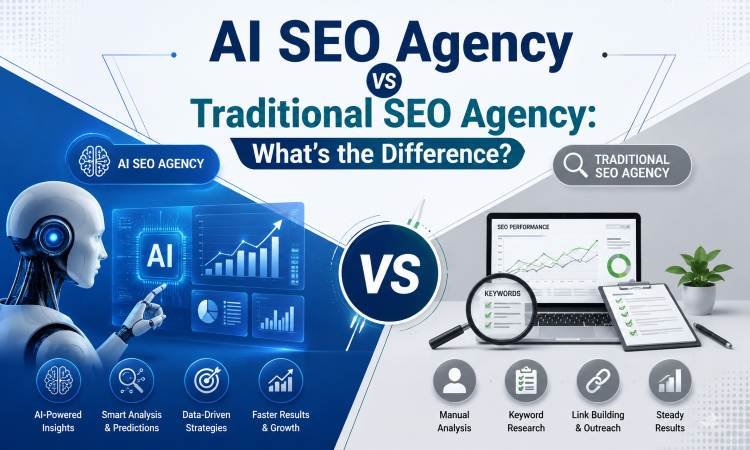
Search behaviour is changing rapidly in 2026. People are not relying only on conventional search-result pages; Google now includes AI-powered experiences such as AI Overviews and AI Mode, while generative AI tools are also becoming part of the information journey. Google confirms that the same foundational SEO practices remain important for these AI features, including technical accessibility and helpful, reliable, people-first content.
This creates an important question for businesses: what is the difference between an AI SEO Agency and a traditional SEO Agency? The answer is not that one replaces the other. The principal distinction is how technology, data, research and human expertise are combined.
What Is a Traditional SEO Agency?
A traditional SEO Agency generally focuses on improving a website's visibility in conventional organic search. Its work can include technical SEO, keyword research, content optimisation, internal linking, authority building and performance monitoring.
The approach is usually structured around understanding what people search for and improving website pages so search engines can crawl, understand and rank them effectively. A conventional SEO framework may include:
- Website audits and technical optimisation
- Keyword and competitor research
- On-page content optimisation
- Internal and external link strategies
- Local or ecommerce SEO
- Organic traffic and ranking analysis
These fundamentals remain relevant. Google specifically states that SEO best practices continue to apply to AI-powered search experiences.
What Is an AI SEO Agency?
An AI SEO Agency extends the conventional SEO framework by incorporating artificial intelligence into research, analysis, content workflows and strategic decision-making.
For example, the AI SEO approach described by AP Web World includes AI intent mapping, entity analysis, competitor-gap research, predictive insights and optimisation for AI-driven search experiences. It also combines machine workflows with human strategy rather than treating AI as a substitute for SEO professionals.
The emphasis therefore moves beyond simply targeting individual keywords. It can involve understanding entities, relationships, search intent and the way information may be interpreted or surfaced by generative search systems.
AI SEO Agency vs Traditional SEO Agency: Key Differences
The clearest difference is the method of execution, not the fundamental purpose of SEO.
1. Research and data analysis
Traditional SEO research often revolves around keyword volumes, competition, search intent and competitor analysis. An AI-led approach can process larger datasets and identify patterns, content gaps, entities and intent relationships more rapidly.
AP Web World describes AI SEO workflows involving entity and intent mapping, competitor benchmarking and predictive priorities.
2. Content creation and optimisation
A traditional approach may depend heavily on manual research, editorial planning and optimisation. AI can assist with topic clustering, research, content structuring and large-scale analysis.
However, automation does not automatically mean better content. Google recommends original, valuable, people-first material and warns against using automation primarily to manipulate rankings or mass-produce low-value pages.
Therefore, the stronger model is generally AI-assisted rather than AI-only.
3. Technical SEO and implementation
Both approaches can address technical SEO, including crawlability, indexing, site architecture, structured data and page experience.
The difference is that an AI-led workflow can use machine-assisted analysis to identify technical patterns and prioritise potential improvements. AP Web World's published framework, for example, combines technical fixes with AI-led execution and predictive analysis.
4. Search visibility beyond traditional rankings
This is becoming particularly important in 2026.
Traditional SEO often measures visibility through rankings, impressions, clicks and organic traffic. An AI SEO strategy can additionally consider how content may be understood, cited or surfaced within generative search experiences.
Google explains that AI Overviews and AI Mode can show relevant links to help users explore information, while eligibility still depends on meeting normal Search technical requirements and being indexed.
Traditional SEO vs AI SEO: A Quick Comparison
Why Traditional SEO Still Matters
It would be misleading to treat AI SEO as a replacement for conventional SEO.
Google's current documentation makes this particularly clear: there are no additional technical requirements specifically required for appearing in AI Overviews or AI Mode. Websites still need to be accessible to Google, indexed and eligible for normal Search, while helpful and reliable content remains fundamental.
Technical foundations, strong content, internal architecture, authority and user experience therefore remain the bedrock. AI changes the workflow and expands the scope; it does not erase the fundamentals.
Which Approach Is Right for a Business?
The right approach depends on a website’s objectives, competition, scale, and available resources. A smaller business with a focused local market may benefit from a straightforward SEO strategy built around technical health, local visibility, useful content, and relevant search intent. Larger organisations operating across multiple topics or markets may benefit from AI-assisted research, entity mapping, predictive analysis, and scalable content workflows.
For example, Ap Web World combines traditional SEO fundamentals with AI-driven strategies, showing how businesses can use both approaches according to their specific goals. The focus should remain on selecting methods that support sustainable search visibility rather than simply adopting AI because it is trending.
The crucial point is quality. Google recommends creating content that provides genuine value instead of producing large volumes of pages solely to attract search traffic or influence generative search results.
The Future of SEO: Human Expertise + Machine Intelligence
The emerging model is not really AI versus traditional SEO. It is a convergence of both.
AI can accelerate research, identify patterns and support complex analysis. Human specialists provide judgement, subject understanding, editorial accuracy and strategic direction. AP Web World describes this combined model as a workflow in which AI supports research, execution and predictive insights while senior human strategy remains involved.
That balance is important because search engines are becoming more sophisticated about relevance, quality and context. Google's latest guidance similarly emphasises unique, valuable, non-commodity content and says that foundational SEO remains essential for generative AI search.
Conclusion
The difference between an AI SEO Agency and a traditional SEO Agency lies mainly in the tools, workflows and breadth of analysis used to achieve search visibility. Traditional SEO remains centred on strong technical foundations, useful content, authority and organic search performance. AI SEO adds machine-assisted research, entity and intent analysis, predictive insights and consideration of emerging AI-powered search experiences.
In 2026, the most practical approach is not to abandon traditional SEO. It is to strengthen those proven fundamentals with intelligent automation and human judgement. That combination creates a more adaptable SEO framework for a search environment that is becoming increasingly contextual, conversational and AI-assisted.
Tags : .....