AI Agents for Business: How Companies Can Automate Customer Conversations in 2026
By Stella Morgan 03-09-2026 1
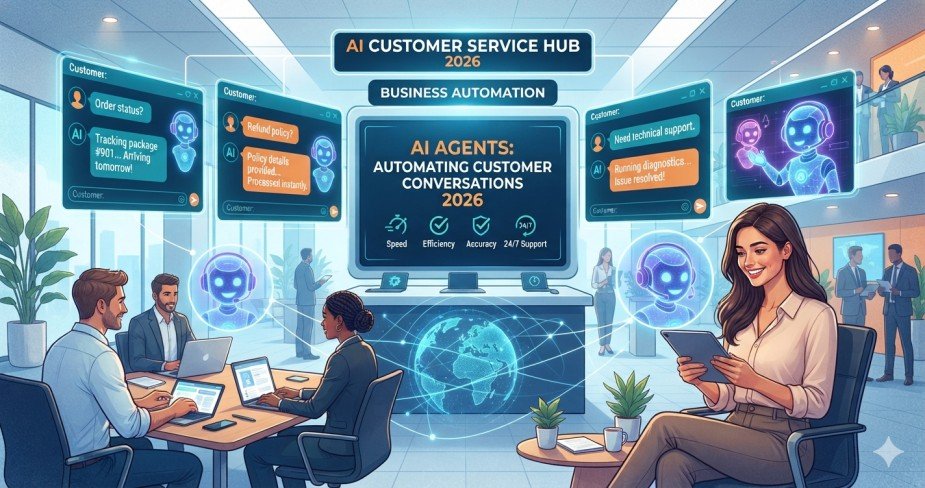
Businesses in 2026 are looking for smarter ways to communicate with customers while reducing repetitive work. Customer expectations have also changed. People want quick answers, personalized interactions, and support that is available whenever they need it.
This is where AI agents for business are becoming increasingly valuable. Unlike traditional chatbots that mainly follow predefined responses, AI agents can understand customer questions, process information, and assist users through more natural conversations.
For companies that want to improve customer service and automate communication, AI agents can become an important part of their digital strategy.
What Are AI Agents?
AI agents are software systems that use artificial intelligence to understand user requests and perform tasks based on those requests. They can communicate with customers, answer questions, provide information, collect details, and in some cases help complete specific business processes.
Traditional chatbots usually depend on fixed conversation flows. If a customer asks something outside the programmed options, the chatbot may struggle to provide a useful response.
AI agents are designed to be more flexible. They can understand different ways of asking the same question and respond according to the context of the conversation.
For example, instead of requiring a customer to select “Order Status” from a menu, an AI agent can understand a message such as:
“Can you tell me where my order is?”
The agent can then provide an appropriate response based on the information available to it.
Why Businesses Are Using AI Agents in 2026
Customer communication can consume a significant amount of time for businesses. Support teams often answer the same questions repeatedly, such as pricing inquiries, product information, order updates, appointment details, and basic troubleshooting.
AI agents can help automate these repetitive conversations.
1. 24/7 Customer Support
One of the biggest advantages of AI agents is their availability. Customers do not always contact a business during working hours.
An AI agent can respond to common questions at any time, helping businesses provide continuous support without requiring employees to remain online around the clock.
This can be particularly useful for companies serving customers across different countries and time zones.
2. Faster Responses
Customers generally do not want to wait several hours for an answer to a simple question.
AI agents can respond almost instantly to common requests. Faster responses can improve the overall customer experience and reduce the number of customers waiting for support.
Human employees can then focus on more complex conversations that require judgment, empathy, or specialized knowledge.
3. Reduced Repetitive Work
Customer service teams may spend large amounts of time answering repetitive questions.
For example, an online store might receive hundreds of questions every month about:
- Shipping times
- Return policies
- Product availability
- Payment methods
- Order tracking
- Discounts
- Business hours
An AI agent can handle many of these routine conversations automatically, allowing employees to spend more time on valuable tasks.
AI Agents vs. Traditional Chatbots
Although AI agents and traditional chatbots are sometimes used interchangeably, there is an important difference.
Traditional chatbots commonly operate using predefined rules, menus, and decision trees. They can be effective for simple workflows but may have difficulty when customers use unexpected wording.
AI agents can use modern AI models to understand natural language and conversational context.
For example, a traditional chatbot might require:
Customer: Select option 1 for order information.
An AI agent could instead understand:
Customer: “I placed an order yesterday. Has it been shipped yet?”
The second approach creates a more natural experience because customers can communicate normally instead of learning how to interact with a rigid chatbot.
How Businesses Can Build AI Agents
Creating an AI agent no longer necessarily requires a large development team. Modern platforms make it easier for businesses to create AI-powered customer experiences without building every component from scratch.
An AI agent builder can help businesses create, configure, and deploy AI agents for specific customer communication requirements.
Businesses can define the purpose of the agent, provide relevant information, configure its behavior, and connect it with the channels or tools required for customer interactions.
The exact setup depends on the business. An ecommerce company may need an agent for product questions and order support, while a service company might use an AI agent for lead qualification and appointment inquiries.
Common Business Use Cases for AI Agents
AI agents can be used across many industries and departments.
Ecommerce
Online stores can use AI agents to help customers find products, answer questions about product features, provide shipping information, and assist with order-related questions.
For example, a customer could ask:
“Do you have this product in another size?”
Instead of waiting for a support representative, the customer can receive an immediate response.
Lead Generation
AI agents can also help businesses qualify potential customers.
An agent can ask questions about a visitor's needs, budget, requirements, or timeline. Based on the conversation, the business can identify promising leads and pass qualified prospects to its sales team.
This can make the sales process more efficient.
Appointment Scheduling
Businesses such as clinics, agencies, consultants, and service providers can use AI agents to answer questions and help customers with appointment-related conversations.
Instead of requiring employees to manually handle every scheduling inquiry, an AI agent can manage common requests and collect the information needed for the next step.
Customer Support
Customer support remains one of the strongest use cases for AI agents.
Agents can answer frequently asked questions, provide troubleshooting guidance, explain policies, and direct customers to the appropriate resources.
When a conversation requires human attention, the system can route the customer to a support representative.
What Makes a Good AI Agent?
Simply adding AI to a customer service process does not guarantee a good customer experience. Businesses need to design their agents carefully.
Clear Purpose
An AI agent should have a defined role. Instead of trying to handle everything, businesses should identify the specific problems the agent needs to solve.
Accurate Information
The quality of an AI agent's responses depends heavily on the information available to it. Businesses should provide accurate and updated information about products, services, policies, and processes.
Human Handoff
AI should not replace human support in every situation. Some conversations require empathy, judgment, or specialized knowledge.
A good AI customer service strategy should include a clear way to transfer complicated conversations to a human representative.
Continuous Improvement
Businesses should monitor conversations and identify areas where the AI agent can improve.
Customer questions can change over time, and business policies may also change. Regular updates help keep the agent useful and accurate.
Benefits Beyond Customer Support
The value of AI agents goes beyond answering customer questions.
Businesses can use AI agents to support internal operations, sales, marketing, lead qualification, onboarding, and other workflows.
For example, a sales team could use an AI agent to answer initial product questions before a salesperson joins the conversation. A marketing team could use an agent to engage website visitors and collect useful lead information.
This means AI agents can become part of a broader business automation strategy rather than simply functioning as customer support tools.
How to Get Started With AI Agents
Businesses interested in AI agents should start with a specific problem rather than attempting to automate everything at once.
First, identify repetitive conversations that take up employee time. Next, determine which questions can be answered using existing business information.
After that, create an AI agent around that specific use case and test it with realistic customer questions.
Businesses should also define when the AI should hand a conversation to a human. This creates a balance between automation and personal support.
Once the initial agent performs well, businesses can expand its capabilities and introduce AI automation into additional areas.
The Future of AI-Powered Customer Conversations
AI agents are likely to become an increasingly important part of business communication. As AI technology improves, agents will become better at understanding context, handling complex requests, and working across different business processes.
The goal is not simply to replace human conversations. Instead, businesses can use AI to handle repetitive interactions while allowing employees to focus on conversations where human involvement creates the most value.
For companies, this can mean faster customer responses, more efficient teams, and a better overall customer experience.
Final Thoughts
AI agents are changing the way businesses communicate with their customers in 2026. They can provide 24/7 assistance, automate repetitive questions, support lead generation, and help customer service teams work more efficiently.
The most successful businesses will likely be those that use AI strategically rather than simply adding automation for its own sake.
By choosing a clear use case, providing reliable information, maintaining human handoff options, and continuously improving the system, companies can build AI-powered customer experiences that are both efficient and useful.
For businesses looking to create their own AI-powered customer communication system, using an AI agent builder can be a practical way to start building and deploying an AI agent around their specific requirements.
Tags : .....