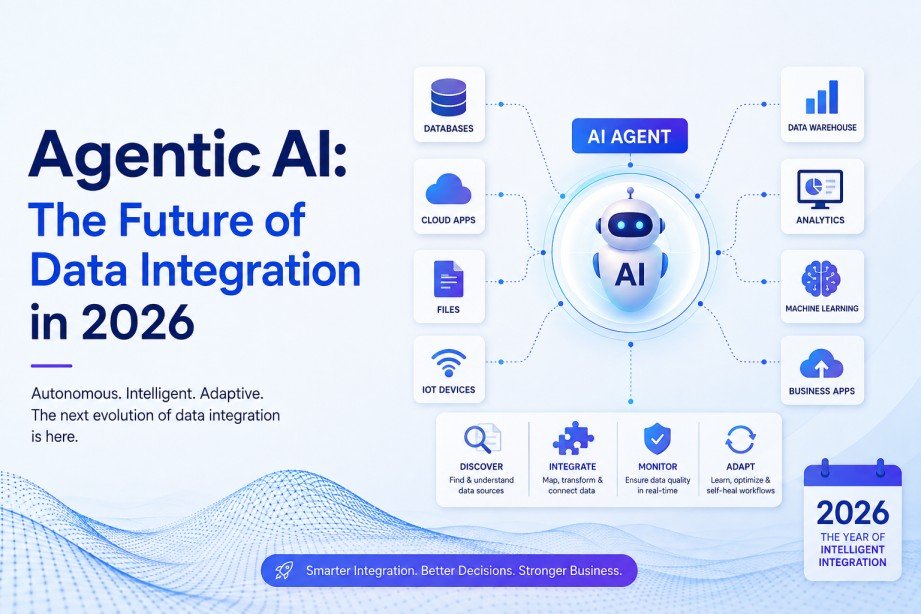
Imagine your bank, your phone app, and your work calendar all talking to each other. Nothing breaks. Sounds simple, right? In reality, it rarely is. This is exactly the kind of problem modern data integration services are built to solve.
So why is it so hard? Traditional computer systems act like old, fragile machinery. If one small piece changes, the whole system can crash. For example, a file format shifts, an API updates, or a spreadsheet column gets renamed. As a result, the entire pipeline grinds to a halt.
So what is "data integration"? Simply put, it's moving information from Place A to Place B. This lets people actually use it. In other words, it's pulling numbers out of one system and making them useful in another. In 2026, this work is being rebuilt around AI. Not AI that just assists, but AI that acts.
And what is "Agentic AI"? Traditional AI answers questions. Agentic AI, however, doesn't wait to be asked. Instead, it takes action, makes decisions, and solves problems on its own. That's why it's reshaping how businesses handle data in 2026.
Data Integration Services: Old Way vs. The Agentic AI Way
The Old Way (Manual Work) is like building a bridge out of wood. It works fine — until the river shifts. Then, you have to rebuild the whole bridge by hand, plank by plank, while everything downstream waits.
The Agentic AI Way (Smart Work) is different. Instead, picture a digital traffic cop. It builds new bridges automatically whenever traffic patterns change. As a result, there's no waiting, no manual rebuild, and no downtime.
The differences show up fast in day-to-day work:
- Fixing errors: Old systems send an alert, and then a human has to step in. Agentic AI, on the other hand, fixes the error itself — often before anyone notices.
- Handling changes: Old systems break the moment a format changes. Agentic AI, however, reads the new format instantly and adapts on the fly.
Three Big Ways Agentic AI Helps Businesses
It fixes itself (self-healing). For instance, a connection breaks at midnight. The AI repairs it, so no one wakes up. As a result, there are no 3 a.m. calls and no missed morning reports.
It understands plain English. Simply ask it: "Combine sales records from yesterday and put them in a spreadsheet." Then, it handles the technical work behind the scenes — no code required.
It reads unstructured information. The AI pulls key facts from PDFs, emails, and phone notes. After that, it organizes everything neatly. The result is clean, structured data, ready to use.
This is why agentic data integration is becoming one of the most talked-about AI tools for business in 2026. After all, it doesn't just move information — it also cleans it, understands it, and prepares it for use.
Meet the Team of AI Digital Assistants
Think of Agentic AI less like one tool. Instead, think of it as a small team working together:
- The Collector gathers information from apps, websites, and files.
- The Inspector then checks the information for mistakes or missing details.
- The Organizer sorts and formats everything so it looks clean.
- The Manager, finally, oversees the whole process and makes sure every assistant works together smoothly.
Each "assistant" handles one job. Together, however, they replace work that used to take an entire data team hours, or even days.
Keeping Humans in Control
Even so, businesses don't hand over the keys entirely. Agentic AI works best with clear boundaries:
- Humans set the rules. The AI makes quick, in-the-moment decisions, but humans define the safety guidelines first.
- Full visibility. You can always check a clear history log, which shows exactly why the AI made a decision. In short, nothing happens in a black box.
- Keeping information safe. Strict rules protect confidential data, so unauthorized eyes never see it, even as the AI moves and reshapes it.
Real-World Examples
- Online shopping: Stock levels update automatically, so your website, warehouse, and shipping tracker stay in sync. As a result, customers never order something that's already sold out.
- Customer support: Customer records connect instantly, so support agents see a full history the moment a call comes in — instead of digging through five different systems.
- Healthcare: Patient schedules and medical updates come together on their own. Consequently, there's less manual entry, fewer errors, and more time for staff.
Conclusion: The Big Picture
In short, Agentic AI takes away tedious digital paperwork. Because of this, people can focus on growing the business instead of babysitting broken pipelines.
In 2026, success won't belong to the companies with the biggest data teams. Instead, it will belong to the companies that let AI handle the backend setup. This, in turn, frees humans to focus on the big-picture ideas that actually move a business forward. Ultimately, choosing data integration services built around agentic AI, rather than legacy manual pipelines, is quickly becoming the line between businesses that scale smoothly and those stuck firefighting broken connections.
Tags : .....