Admission to Graduation – Turning Student Journey Into A Digital Story
By Tiffani Leilah 30-08-2026 85
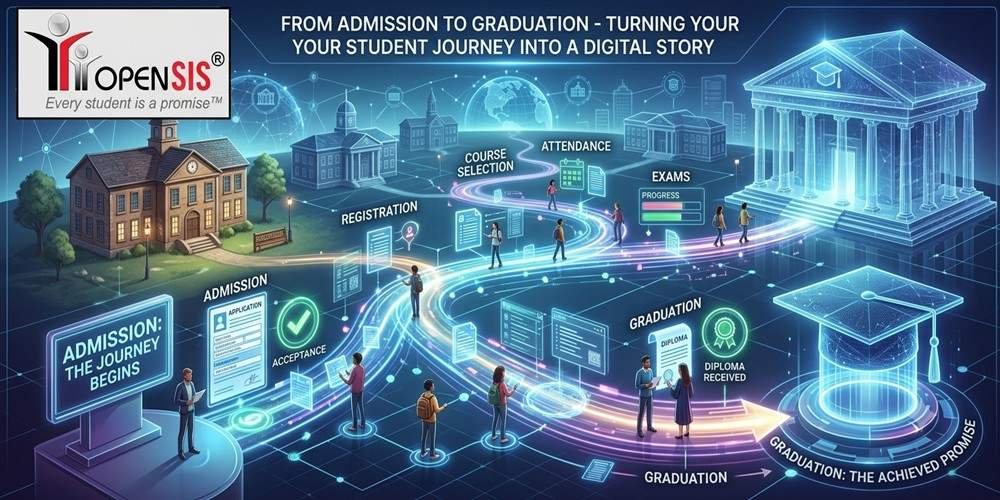
A student’s academic journey is a story. On paper, it looks like a neat progression. It begins from admission and ends with graduation. However, the reality often adds some nice twists to the path. Students enter the academic landscape with one ambition in mind, and sometimes during semesters their ambition changes, new courses come out, new professions emerge, and that often leads to transfer to a different section, enrolling in different courses, and even dropping out to pursue something new. For schools that are managing everything manually, keeping track of this can be difficult. It is not because schools lack talent or efficiency, but because keeping track of everything under a fragmented data system does not always work properly. This is the time you need a well-designed K-12 management software system to support your school administration as they turn student data into a digital story of academic journeys.
The Main Problem With Digital Footprint
What makes digital tracking of students’ academic journey so difficult? When schools are operated manually, data scattering becomes the main challenge. With information fragmentation, it becomes extremely difficult to consolidate every piece of information.
This is the reason a digital infrastructure becomes necessary for modern schools. An Educational institution management system like openSIS will transform the administrative management in various ways.
- Data automation
- AI insight
- Data authentication
- Ease of report generation
- Data centralization
- Student information management
- Communication ease
- Real-time data visibility
The list will grow longer with passing time because every day these systems are bringing something new to explore. They are constantly fine-tuning their digital systems to reshape school operations and elevate the student education experience.
Think about what happens when someone enrolls in a school. The school administrators perform a series of tasks for onboarding the student.
- They collect personal information
- They hand out admission forms
- They collect students’ previous academic history
- They collect family details
- They collect health data
And in the end, they collect all the filled-out forms and enter the data somewhere. If the school is managing under a manual system, the data goes to the first set of spreadsheets. Otherwise, the information goes to different software systems dedicated to different departments.
Now, imagine teachers, counselors, the finance department, and healthcare staff are all using their dedicated files and entering their set of data every day. And administrators are collecting all these daily. However, the story does not end here. Before submitting reports, administrators have to verify the information to ensure accuracy.
The process alone consumes a lot of time because it is not the information of one student the school is managing. There are thousands of students, and everyone has –
- Attendance
- Grade
- Performance
- Health
- Behavior
- Sports
All these pieces of information build the student's academic story together. When operated manually, missing something or overlooking something is not uncommon. Human error is not a sign of inefficiency. It occurs when volume increases, and tasks come with a deadline. An Educational institution management system not only helps in data automation and data processing, but this system also helps teachers create courses based on student merits as well.
One Student, One Journey
The central idea behind every modern student information system is the consolidation of student data. Students’ journeys don’t always follow linear paths. Young people change courses, grow new hobbies, become good at something, lose interest in something, find pleasure in sports, become obsessed with new ideas, and all these are pieces that build their progress story. And to track it, you need a well-implemented system supporting your staff.
Lastly,
A K-12 management software system becomes essential because disconnected data systems create disconnected academic stories. Decision-making becomes a trying task when a piece of information is missing. Institutions possess the information. The challenge lies in assembling it in a proper way. This is why digitization has become the modern school operation essential.
1. How can a Student Information System manage the student journey?
An SIS connects student information across admissions, enrollment, academics, attendance, support, and graduation.
2. What is K-12 management software?
K-12 management software helps schools manage student information, academic operations, administrative workflows, and other core processes digitally.
3. How does an educational institution management system support student records?
It centralizes and organizes student information throughout the student's enrollment lifecycle.
4. Can an SIS connect admissions and enrollment?
Yes, an SIS can help transfer relevant applicant information into the student's ongoing institutional record.
5. How does an SIS improve attendance management?
It digitally records attendance and connects attendance information with the student's broader academic record.
Tags : Admission to Graduation