Introduction: Your First ACT Test Doesn't Have to Be Stressful
Let's be honest — walking into your first ACT test can feel overwhelming. You've studied for weeks (or months), and now it's the real deal.
But here's what most Singapore students don't realise: half the battle is simply knowing what to expect. Students who understand the test day process feel calmer, perform better, and avoid silly mistakes that cost points.
I've coached hundreds of Singapore students through their first ACT test preparation, and the pattern is clear. The students who walk in prepared — not just academically, but logistically — consistently outperform those who don't.
This guide covers everything: what to bring, what happens hour by hour, common traps, and real strategies from students who've been exactly where you are now.
What Is the ACT Test? A Quick Refresher
The ACT is a standardised college admissions exam accepted by virtually all US universities. It's also increasingly accepted by universities in the UK, Canada, Australia, and Hong Kong.
Here's the structure at a glance:
Total testing time: About 2 hours 55 minutes (3 hours 35 minutes with Writing).
Each section is scored 1–36, and your composite score is the average of all four sections.
Before Test Day: The Week-Before Checklist
The biggest mistakes happen before you even sit down. Here's your pre-test-day checklist:
Documents You Must Bring
- Valid passport (Singapore NRIC alone is NOT accepted)
- Printed admission ticket (screenshot on your phone won't work)
- Approved photo ID matching your registration name exactly
What to Pack the Night Before
- Several sharpened No. 2 (HB) pencils — NOT mechanical pencils
- A permitted calculator (TI-84 is the most popular choice)
- A reliable watch with NO smart features (no Apple Watch, no Casio with Bluetooth)
- Snacks and water for the break (you'll thank yourself later)
- A clear zip-lock bag for your items
What NOT to Bring
- Mobile phones (must be completely powered off and stored)
- Highlighters, coloured pens, or rulers
- Scratch paper (you'll use the test booklet margins)
- Any electronic devices besides your approved calculator
🎯 Pro Tip from Tutors: I've seen students turned away at the door because their admission ticket name didn't match their passport exactly — even a missing middle name caused issues. Double-check this a week before, not the morning of.
Test Day Morning: Hour-by-Hour Timeline
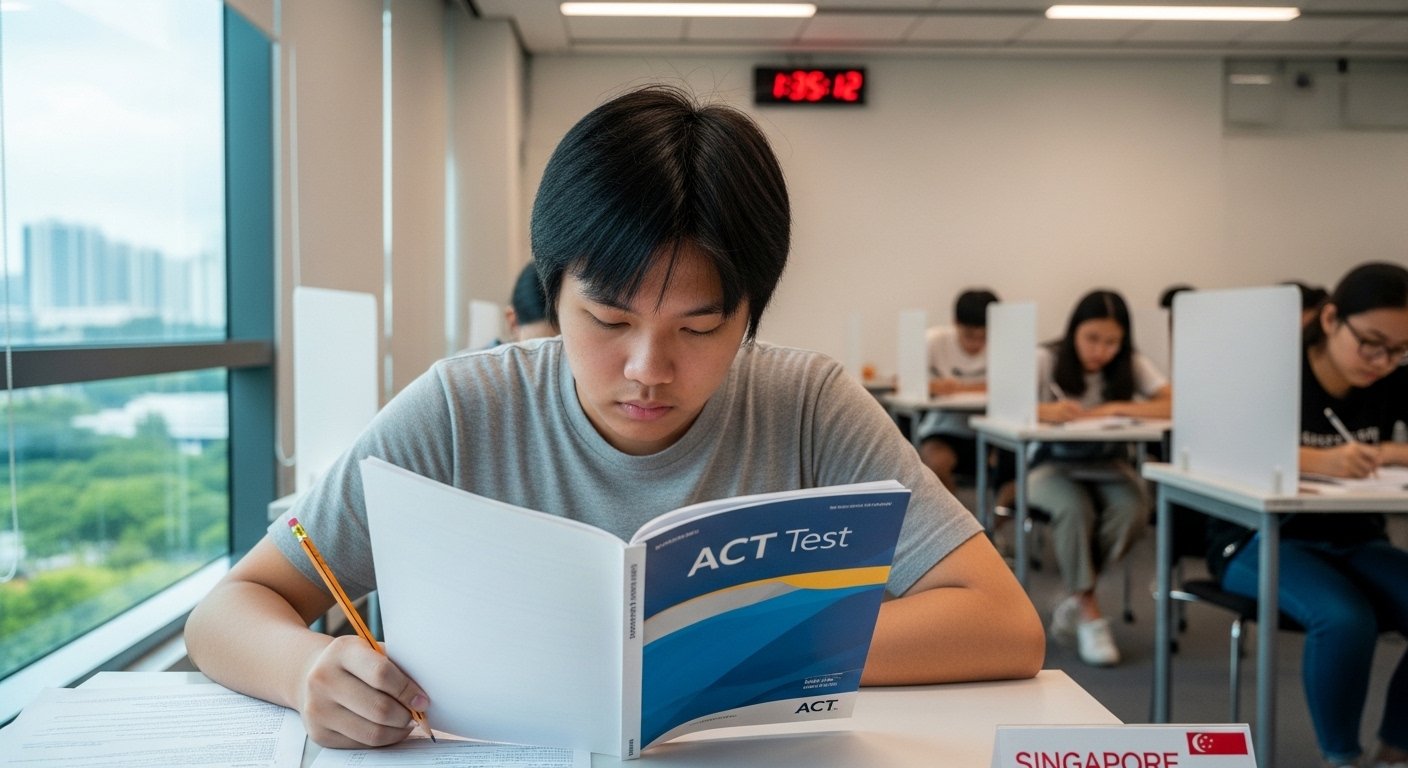
Here's what a typical test day looks like at a Singapore test centre:
7:15 AM — Arrive at the test centre. Yes, this early. Doors usually close by 8:00 AM sharp.
7:30–8:00 AM — Check-in. You'll show your ID and admission ticket, get assigned a seat, and hear the rules read aloud.
8:00–8:15 AM — Bubbling in personal information on the answer sheet. This takes longer than you think.
8:15 AM — English section begins.
~9:00 AM — Math section begins.
~10:00 AM — Break (10–15 minutes). EAT SOMETHING.
~10:15 AM — Reading section begins.
~10:50 AM — Science section begins.
~11:30 AM — Optional Writing section (if registered).
~12:15 PM — Dismissed.
A Real Student Scenario
Raihan, a JC1 student from Tampines, arrived at his test centre at 7:50 AM. The queue was already long. He barely made it inside before the doors closed, and his hands were shaking when the English section started. His advice? "Come at 7:15. Sit down, breathe, and get comfortable before they even start talking."
What Happens During Each Section
English (45 Minutes, 75 Questions)
This section moves FAST — you get roughly 36 seconds per question. The passages have underlined portions, and you pick the best revision.
What Singapore students should know:
- American English conventions apply (e.g., serial comma usage)
- Rhetoric questions ask about purpose, tone, and organisation — not just grammar
- Don't overthink. The "most concise" answer is often correct.
Math (60 Minutes, 60 Questions)
Questions go from easy to hard. The first 20 are straightforward; the last 15 can be tricky.
Common mistakes Singapore students make:
- Spending too long on hard questions early and running out of time
- Forgetting that the ACT Math section includes trigonometry (unlike some local syllabi)
- Not using the calculator strategically — some questions are faster by hand
🎯 Pro Tip: If a question takes more than 90 seconds, circle it, guess, and move on. Come back if you have time. At The Princeton Review Singapore, we call this the "90-Second Rule" — and it works.
Reading (35 Minutes, 40 Questions)
Four passages: Prose Fiction/Literary Narrative, Social Science, Humanities, Natural Science. Ten questions each.
Strategy that works:
- Read the passage first (spend about 3 minutes reading)
- Answer questions in order — they generally follow the passage chronologically
- Don't rely on memory. Go back and find evidence in the text.
Many Singapore students tell me reading is their hardest section because of time pressure. It's not about reading speed — it's about reading strategically.
Science (35 Minutes, 40 Questions)
This section surprises most first-timers. It's NOT a science knowledge test. It's a data interpretation test.
What to expect:
- Graphs, tables, and charts you've never seen before
- Conflicting viewpoints passages (two scientists disagree — you analyse both)
- Very little actual science knowledge required (maybe 3–4 questions)
Biggest mistake: Reading every word of the experiment descriptions. You should go straight to the questions and refer back to the data as needed.
Writing/Essay (Optional, 40 Minutes)
You'll read a prompt with three perspectives on an issue and write an essay presenting your own position.
Should you take it?
5 Common Test Day Mistakes Singapore Students Make
Based on years of coaching, here are the traps I see students fall into:
- Not eating breakfast. Your brain needs fuel for a 3+ hour exam. A banana and some toast can literally improve your score.
- Wearing uncomfortable clothes. Test centres can be freezing cold. Bring a light jacket even in Singapore's heat.
- Changing answers too often. Research consistently shows your first instinct is usually correct. Only change an answer if you find clear evidence it's wrong.
- Panicking during the Reading section. The time pressure is real, but panicking makes it worse. Take one deep breath between passages.
- Forgetting to bubble in answers. Some students circle answers in the booklet and forget to transfer them to the answer sheet. Bubble as you go — don't save it for the end.
How the ACT Test Differs from Exams Singapore Students Are Used To
If you're coming from the Singapore education system, here's what might feel different:
Key takeaway: There is NO penalty for guessing on the ACT. Never leave a question blank. Even a random guess gives you a 25% chance.
Real Preparation Strategies That Work
6–8 Weeks Before Test Day
- Take a full-length practice test under timed conditions
- Identify your two weakest sections
- Focus 60% of study time on weaknesses, 40% on maintaining strengths
3–4 Weeks Before Test Day
- Do timed section drills (e.g., one full Reading section in 35 minutes)
- Review every wrong answer — understand why you got it wrong
- Simulate real test conditions: early morning, timed, no phone
Final Week Before Test Day
- Light review only — no cramming
- Confirm your test centre location (visit it if possible)
- Lay out everything you need the night before
- Sleep by 10 PM the two nights before (not just the night before)
🎯 Pro Tip: The second-to-last night's sleep matters MORE than the night before. Most students are too anxious to sleep well the night before — that's normal. Bank your rest earlier.
Mini Case Study: How Mei Ling Improved by 5 Points
Student: Mei Ling, Year 11, international school in Singapore
First practice test score: 26 composite
Goal: 31+ for US university applications
What she did:
- Identified Science and Reading as her weakest sections
- Practised Science passages using the "data-first" strategy (skip descriptions, read questions, then find answers in charts)
- Used a timer app during every Reading practice session
- Took 4 full-length practice tests over 8 weeks
- Reviewed every single wrong answer in a dedicated "error journal"
Test day score: 31 composite.
Her takeaway: "I didn't study more. I studied smarter. Knowing how the test works was half the battle."
What Happens After the Test
- Scores are released about 2–3 weeks after your test date
- You can access scores online through your ACT web account
- Score reports can be sent to up to 4 colleges for free (if selected on test day)
- You can superscore at many universities — they take your best section scores across multiple test dates
FAQs: ACT Test Day for Singapore Students
Q: Where are ACT test centres in Singapore?
A: Common centres include Singapore American School and other approved international schools. You'll choose your centre during registration. Spots fill up fast — register early.
Q: Can I take the ACT more than once?
A: Yes. Most students take it 2–3 times. Many universities accept superscores.
Q: What if I feel sick on test day?
A: You can choose not to have your scores reported. You'll need to request this through your ACT account after the test.
Q: Is the ACT test harder than the SAT?
A: Neither is objectively harder. The ACT has a Science section, tighter time pressure, and more questions per section. Some students prefer it; others prefer the SAT. Take a practice test of each to find your fit.
Q: Should I take the optional Writing section?
A: If any university on your list requires or recommends it, yes. When in doubt, take it.
Q: What calculator can I use?
A: Most graphing calculators are allowed (TI-84, TI-Nspire without CAS). Calculators with computer algebra systems (CAS), phones, and tablets are NOT allowed.
Conclusion: You're More Ready Than You Think
Here's the truth — your first ACT test will feel intense. That's completely normal.
But if you walk in knowing the format, the timing, and the logistics, you've already eliminated half the stress. The students who succeed aren't always the "smartest." They're the ones who prepare strategically and stay calm under pressure.
Start your preparation early. Practise under real conditions. Learn from your mistakes. And on test day, trust your training.
You've got this, Singapore.
Tags : ACT Test