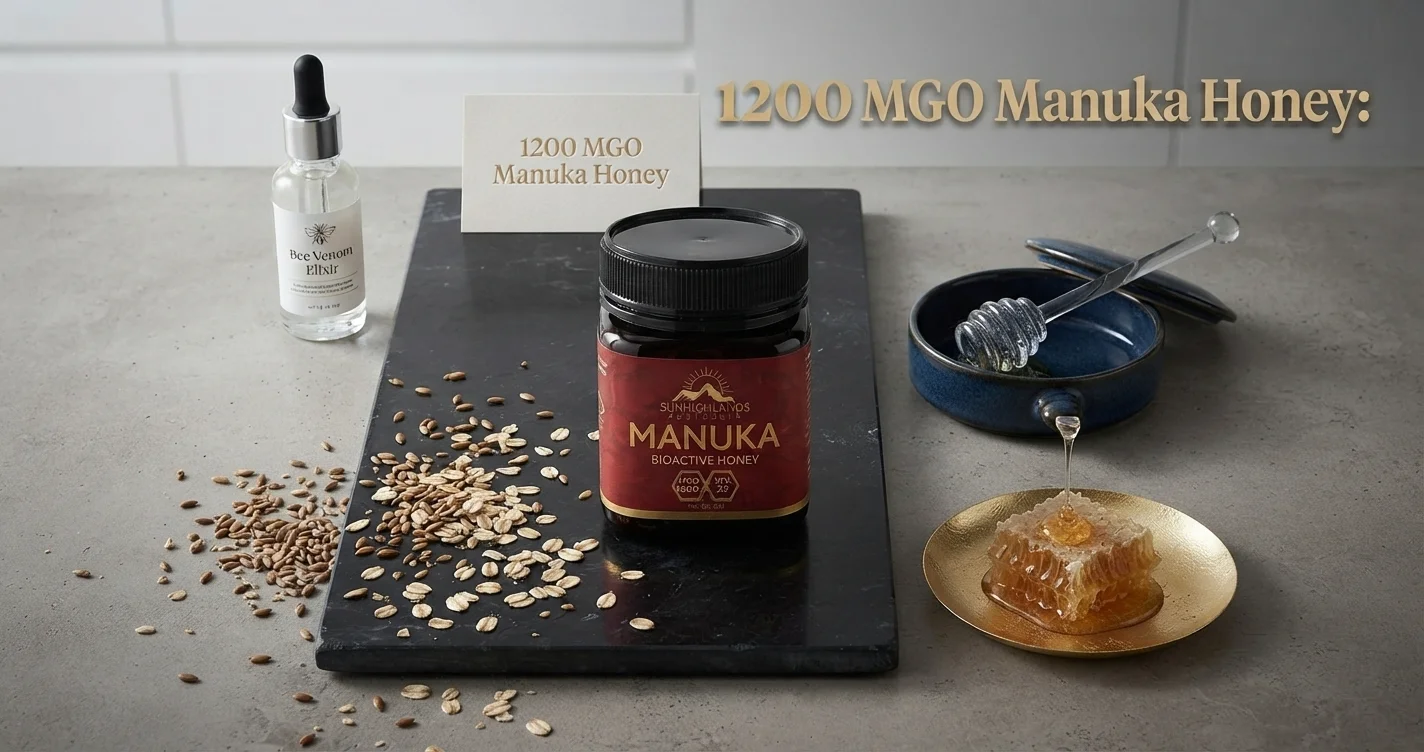
Shopping for Manuka honey can be confusing when jars display different MGO numbers, quality marks, origins and price points. If you are considering Manuka Honey MGO 1200, understanding these labels can help you compare products more confidently and choose one that suits your preferences.
MGO 1200 is a high concentration rating for methylglyoxal, a naturally occurring compound associated with Manuka honey's characteristic activity. However, the number alone does not tell you everything about authenticity, freshness, origin or overall product quality.
Whether you are exploring Manuka honey Australia products for the first time or comparing premium options before purchasing, this guide explains what to look for, which label details matter and how to evaluate value without relying on marketing claims alone.
What Does 1200 MGO Manuka Honey Mean?
MGO stands for methylglyoxal, a compound that develops in Manuka honey from dihydroxyacetone (DHA), which occurs naturally in the nectar of certain Leptospermum plants. During honey maturation, DHA converts into MGO. The Australian Manuka Honey Association (AMHA) identifies MGO as an important measurable characteristic of Australian Manuka honey.
An MGO 1200 rating generally means the honey contains approximately 1,200 milligrams of methylglyoxal per kilogram. The figure describes concentration, rather than the amount you should consume.
For context, MGO 1200 has a higher measured MGO concentration than MGO 550 or MGO 850. This makes it a high-MGO option for consumers who specifically want a greater concentration of this compound.
However, a higher MGO number does not automatically mean better flavour, fresher honey, greater authenticity or a guaranteed health benefit. These are separate considerations when comparing products.
How to Read a Manuka Honey Label
A product label provides useful information beyond its headline rating. When comparing different jars, start with these five details.
1. Check the MGO rating
Look for the MGO number and confirm that it is clearly associated with the specific product you are buying. A rating such as MGO 1200+ indicates a high-MGO product, but it should not be interpreted as a medical dosage or a promise of a particular result.
Also consider whether the seller explains how the stated concentration is tested. Independent laboratory testing can help substantiate the MGO claim and give shoppers more information than a rating alone.
2. Verify the country of origin
If your priority is Australian Manuka honey, check that the product is clearly identified as Australian.
Australian Manuka honey is produced by bees collecting nectar from Leptospermum plants. Depending on the floral sources contributing to the honey, Australian Manuka may be monofloral or multifloral.
The AMHA has established criteria for identifying authentic Australian Manuka honey. Its Mark of Authenticity is associated with Australian production and independent testing against defined criteria for naturally occurring compounds, including MGO and DHA.
You can read the association's Australian Manuka honey quality standards to understand how origin and authenticity are assessed.
3. Look for testing and traceability
A trustworthy product description should provide clear information about its stated characteristics and quality checks.
Look for independent laboratory testing, batch information where available, and details about the producer or seller. Traceability can help connect a product to its production and testing history.
Do not assume that every jar carrying an MGO number automatically has a particular certification. If a product displays an authenticity mark, check what organisation issued it and what that mark actually verifies.
4. Understand MGO and UMF
MGO and UMF are not interchangeable rating systems.
MGO measures the concentration of methylglyoxal. UMF, or Unique Manuka Factor, is a separate New Zealand quality-assurance system that evaluates four factors: MGO, leptosperin, DHA and hydroxymethylfurfural (HMF). These factors relate to potency, authenticity and freshness-related quality.
The UMF Association explains that MGO cannot be converted directly into an official UMF rating because the systems measure different things. You can review its UMF grading overview for further details.
If a product label uses wording such as “equivalent to UMF 25+”, read the wording carefully. An equivalent-rating comparison is not, by itself, proof that the product holds official UMF certification.
5. Check net weight and serving information
Jar size affects both the initial purchase price and how much honey you receive. Compare net weight, serving guidance and price per 100 grams rather than judging value by the headline price alone.
Serving information also helps you understand the nutritional content and portion size described by the seller. Remember that honey is a source of sugar, including high-MGO Manuka honey.
How to Compare Different MGO 1200 Products
When two products carry a similar MGO rating, compare the details that help establish their value and transparency.
| Comparison factor | What to check |
|---|---|
| MGO concentration | Is the stated rating clear and supported by testing information? |
| Country of origin | Does the seller clearly identify where the honey was produced? |
| Authenticity | Is there a verifiable quality mark or useful traceability information? |
| Certification | Is the mark explained accurately, without confusing MGO with UMF? |
| Jar size | What is the net weight, and how much does each 100g cost? |
| Product details | Are storage advice, serving information and nutritional details available? |
| Price | Are you comparing single jars, bundles or promotional prices on an equal basis? |
For example, imagine two jars both labelled MGO 1200. One provides a clear origin statement and independent testing details, while the other offers little information beyond the rating. Even though their MGO claims look similar, the first gives you more information to evaluate before purchasing.
This is why choosing Manuka honey should involve more than selecting the largest number or the lowest price.
Is MGO 1200 Better Than Lower MGO Grades?
MGO 1200 indicates a higher concentration of methylglyoxal than lower grades such as MGO 550 or MGO 850. Whether that makes it the right choice depends on your priorities.
A shopper who specifically wants high-MGO honey may prefer MGO 1200. Someone buying honey primarily for its taste or everyday food use may place greater emphasis on flavour, serving size and budget.
Higher MGO also does not guarantee superior health outcomes. Research into Manuka honey's properties should not be treated as proof that consuming a particular grade can prevent or treat disease.
If you are considering honey for a medical application, seek professional guidance. Food-grade honey should not automatically be substituted for medical-grade honey intended for clinical wound care.
What Should You Expect From Australian Manuka Honey?
Australian Manuka honey can have a distinctive flavour, aroma, colour and texture. These characteristics can vary with the floral sources, harvest and producer, so there is no single appearance that proves a jar is authentic.
For consumers searching for Manuka honey for sale in Australia, a useful approach is to combine sensory preferences with verifiable product information. Check the origin, MGO rating, testing details and label rather than using colour or thickness as a standalone authenticity test.
Storage matters, too. Follow the producer's instructions, keep the jar sealed, and protect it from excessive heat, moisture and direct sunlight.
Explore Manuka Honey MGO 1200+ at Sunhighlands
If you are comparing high-MGO products, Sunhighlands offers a 250g Manuka Honey MGO 1200+ product listing. The page identifies the product as Australian Manuka honey sourced from northern New South Wales and states that it is independently tested. It also displays the wording “EQV UMF 25+”.
The listing provides serving and nutritional information, including a suggested 10g serving size and 25 servings per 250g jar. Review the current page for full product details, pricing, shipping conditions and availability before placing an order.
Explore Manuka Honey MGO 1200+ 250g
If you are considering buying more than one jar, compare the available MGO 1200+ two-jar bundle with the single-jar option. Check the live prices and quantities to determine which option best suits your needs.
Frequently Asked Questions
What does MGO 1200 mean on a Manuka honey jar?
MGO 1200 generally indicates approximately 1,200 milligrams of methylglyoxal per kilogram of honey. It is a concentration rating, not a serving recommendation or a guarantee of a particular health benefit.
How can I tell whether Australian Manuka honey is authentic?
Look for a clear Australian-origin statement, independent testing details and traceability information. You can also check whether the product carries a recognised authenticity mark and verify what that mark means.
Is MGO 1200 equivalent to UMF 25+?
Not as an official conversion. MGO measures methylglyoxal concentration, while UMF evaluates multiple factors. Some sellers display equivalent-rating comparisons, but these should not be confused with official UMF certification.
Is more expensive Manuka honey always better?
No. Price may reflect factors such as MGO concentration, testing, traceability, production and packaging. Compare the product information, jar size and unit price before deciding whether a particular product offers suitable value.
How should I store MGO 1200 Manuka honey?
Follow the storage instructions on the jar. In general, keep honey sealed and away from excessive heat and moisture. Check the best-before information supplied by the producer.
Can babies have Manuka honey?
No. Australian healthdirect advises that honey should not be given to babies younger than 12 months because of the risk of infant botulism. This applies to Manuka honey as well as other honey.
Final Thoughts
Choosing Manuka Honey MGO 1200 becomes easier when you understand what the rating measures and which other details deserve attention. MGO concentration is important, but it is only one part of a product's story.
Check the country of origin, independent testing, authenticity information, certification wording, jar size and unit price before you buy. For Australian shoppers, these practical checks can make comparing products more transparent and help you choose a jar that matches your preferences.
Rather than relying on a high number or a promotional claim alone, prioritise clear labelling, verifiable information and a seller that explains its product honestly.
Tags : Manuka Honey