Electric Boat and Ship Market Evolution: Navigating the Multibillion-Dollar Shift to Marine Electrification
By Jhone rock 16-10-2026 1
Market Overview:
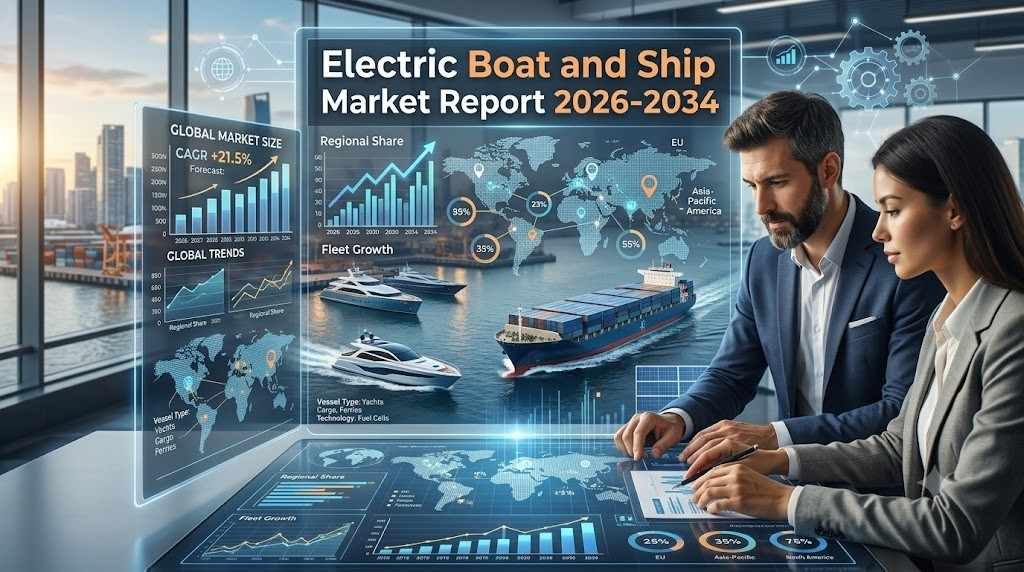
According to IMARC Group’s latest research publication, “Electric Boat and Ship Market: Global Industry Trends, Share, Size, Growth, Opportunity and Forecast 2026-2034”, The global electric boat and ship market grew from USD 7.6 Billion in 2025 to USD 8.3 Billion in 2026. Looking forward, IMARC Group estimates the market to reach USD 15.7 Billion by 2034, exhibiting a CAGR of 8.36% from 2026-2034.
This detailed analysis primarily encompasses industry size, business trends, market share, key growth factors, and regional forecasts. The report offers a comprehensive overview and integrates research findings, market assessments, and data from different sources. It also includes pivotal market dynamics like drivers and challenges, while also highlighting growth opportunities, financial insights, technological improvements, emerging trends, and innovations. Besides this, the report provides regional market evaluation, along with a competitive landscape analysis.
How Electric Boats and Ships Are Reshaping the Global Maritime Industry
- Europe dominates the global electric boat and ship market with a share of 36.7%, driven by stringent emissions reduction targets, government subsidies for eco-friendly maritime transport, and strong investments in electric ferry infrastructure across Norway, the Netherlands, and Germany.
- Hybrid propulsion stands as the largest segment by propulsion type in 2025, offering a transitional solution that reduces fuel consumption and meets environmental regulations while maintaining the operational range needed for commercial and large-scale vessels.
- Lithium-ion batteries dominate the battery type segment owing to their high energy density, fast charging capabilities, and longer lifespan compared to lead-acid and nickel-based alternatives, making them the preferred choice for both commercial and recreational marine applications.
- The passenger carriage segment leads the market, fueled by increasing consumer demand for eco-friendly leisure boating, green tourism expansion, and government incentives promoting sustainable short-distance waterway transport.
- In March 2026, Vision Marine Technologies Inc. reported a 446% year-over-year increase in electric boat sales under contract, with contracted sales totaling USD 1,118,763.50 compared to USD 204,861.20 during the same period a year earlier, reflecting accelerated early-season deployment across multiple electric platforms.
Key Trends in the Electric Boat and Ship Market
- Rising Environmental Regulations and Shift Towards Green Maritime Solutions: Growing stringency of environmental regulations targeting marine pollution and greenhouse gas emissions is a primary factor propelling the market. Maritime transport handles more than 80% of goods exchanged globally by volume, making decarbonization a critical priority. Electric vessels eliminate exhaust emissions entirely, and coastal and inland waterway zones with stringent emission limits are increasingly favoring electric propulsion as companies invest in battery-powered, hybrid, and hydrogen-based marine systems.
- Advancements in Battery Technology and Charging Infrastructure: Continuous innovation in battery technology and the expansion of marine charging infrastructure are fueling market growth. In July 2025, Taiga Motors partnered with marine charging network Aqua superPower to accelerate deployment of scalable, high-speed electric charging facilities across marine settings. The partnership included compatibility with Aqua superPower’s 59 locations across North America and Europe. Modern lithium-ion and solid-state batteries now offer higher energy density, faster charging, and longer lifespans, making them more suitable for commercial and recreational maritime applications.
- Growing Demand for Sustainable Marine Tourism and Leisure Activities: The increasing popularity of eco-friendly recreational boating is a significant growth driver. The global recreational boating market reached USD 24.3 Billion in 2024, with tour operators, resorts, and yacht manufacturers adopting electric propulsion to deliver quiet, emission-free passenger experiences. Electric ferries and small passenger boats are being introduced across lakes, rivers, and coastal zones, while luxury yacht buyers are increasingly drawn to electric models for their combination of innovation, performance, and sustainability credentials.
- Government Initiatives and Infrastructure Investment: Governments are actively promoting electric maritime transport through policy support, subsidies, and infrastructure upgrades. In February 2025, Halifax Port secured USD 22.5 Million to develop a green shipping route with Hamburg, featuring hydrogen projects that enhanced environmental sustainability, supported supply chain decarbonization, and reinforced infrastructure resilience in Canada. National efforts to modernize ports with electric charging docks, smart port systems, and green harbor facilities are creating a highly favorable environment for market growth.
- Expanding Coastal and Inland Waterway Opportunities in Asia Pacific: The Asia Pacific region presents significant market potential owing to its vast coastlines and growing environmental sustainability concerns. As of November 2024, India’s maritime infrastructure included 12 major ports and more than 200 minor ports anchoring a 7,500 kilometer coastline. Rapid urban expansion in coastal cities is driving demand for cleaner marine transport alternatives, while increasing government financial support for green technologies is boosting the adoption of electric boats and ships across maritime operations in the region.
Growth Factors in the Electric Boat and Ship Market
- U.S. Government Funding for Electric Marine Technologies: The U.S. Department of Energy announced USD 43 Million in funding for projects advancing electric vehicle technologies, including marine applications. This investment is directly supporting the development of commercial electric ferries, harbor vessels, and patrol boats, with states such as California, New York, and Washington leading climate-driven fleet electrification mandates. The US renewable energy market reached USD 237.2 Billion in 2024, reinforcing the financial backbone for clean marine propulsion investment.
- Greenhouse Gas Emission Reduction Targets in Europe: At the close of the second quarter of 2024, estimated greenhouse gas emissions from the EU economy were approximately 790 Million Tons of CO2-equivalents. Tighter carbon neutrality goals and emission reduction policies are accelerating the replacement of diesel-powered maritime fleets with electric alternatives, while European nations continue investing in charging facilities and sustainable port infrastructure to support the transition.
- Surge in Tourism Driving Coastal Electric Vessel Demand in MEA: Dubai recorded 14.96 Million overnight guests from January to October 2024, marking an 8% rise from the same period a year earlier. As tourism becomes a cornerstone of the regional economy along coastlines, electric boats are emerging as a superior option for sea travel, targeting sustainability-conscious travelers and supporting a broader regional shift toward eco-tourism.
- India’s Maritime Sector Advancing Electric Vessel Adoption: India’s extensive maritime heritage, anchored by a 7,500 kilometer coastline with 12 major ports and over 200 minor ports, creates a substantial base for electric vessel deployment. Alongside this, the nation’s commitment to climate-resilient development is driving innovation in electric fishing boats, passenger ferries, and inland waterway vessels, signaling a structural shift in India’s marine transportation sector.
- Decarbonization Commitments by Port Authorities and Commercial Operators: Ports and marinas globally are investing in shore-to-ship charging systems, electrified docking infrastructure, and green harbor development. Major ferry, cargo, and tourism companies are making corporate sustainability commitments that are accelerating the procurement of electric watercraft. The aging diesel-powered fleet replacement cycle across North America and Europe is further creating large-scale procurement opportunities for electric vessel manufacturers and battery technology providers.
Leading Companies Operating in the Global Electric Boat and Ship Industry:
- ABB Ltd
- Arc
- Candela
- Duffy Electric Boat Company
- ElectraCraft
- Ganz Boats GmbH (Schweiz)
- Navalt
- Ruban Bleu
- Vision Marine Technologies Inc.
- Wärtsilä
- X Shore
Electric Boat and Ship Market Report Segmentation:
Breakup By Propulsion Type:
- Hybrid
- Pure Electric
Hybrid accounts for the largest segment, offering a balanced approach that reduces fuel consumption and emissions while maintaining the extended operational range required for commercial and large-scale vessels navigating longer distances.
Breakup By Battery Type:
- Lead-acid
- Lithium-ion
- Nickel-based Batteries
Lithium-ion dominates the battery type segment owing to its superior energy density, longer lifespan, and fast charging capabilities, making it the leading technology for both commercial maritime operations and recreational electric vessel applications.
Breakup By Carriage Type:
- Passenger
- Cargo
Passenger leads the carriage type segment, driven by rising consumer demand for sustainable recreational vessels, expanding green tourism, and government incentives promoting electric-powered short-distance waterway passenger transport.
Breakup By Region:
- North America (United States, Canada)
- Asia Pacific (China, Japan, India, South Korea, Australia, Indonesia, Others)
- Europe (Germany, France, United Kingdom, Italy, Spain, Russia, Others)
- Latin America (Brazil, Mexico, Others)
- Middle East and Africa
Europe holds the largest market share at 36.7%, supported by the region’s robust regulatory framework for environmental sustainability, well-established maritime industry, and significant investments by countries including Norway, the Netherlands, and Germany in electric ferry services and sustainable marine transportation infrastructure.
Recent News and Developments in the Electric Boat and Ship Market
- March 2026: Vision Marine Technologies Inc. announced a 446% year-over-year increase in electric boat sales under contract for the period beginning September 2025 through late February 2026, with contracted sales totaling USD 1,118,763.50. The 2026 sales mix reflected expansion across multiple electric models including the Fantail 217, Phantom, Volt 180, and V24 platforms, as well as higher-output configurations powered by the company’s 180E high-voltage propulsion system.
- May 2025: Incat unveiled the world’s largest battery-electric vessel, Hull 096, which will operate as China Zorrilla with a capacity for approximately 2,100 passengers and 225 vehicles. The milestone launch underscored a major shift in large-scale maritime electrification, demonstrating that battery-electric propulsion is now viable for high-capacity passenger and vehicle ferry operations at a commercial scale.
- May 2025: The ICAR-Central Institute of Fisheries Technology’s Mumbai Research Centre inaugurated ‘Vikalpika,’ India’s first electric fishing boat, at Gorai Creek, Mumbai. The launch marked a landmark step toward reducing carbon emissions in marine activities, aligning with India’s commitment to sustainable and climate-resilient development in the fisheries and coastal transport sectors.
Note: If you require specific details, data, or insights that are not currently included in the scope of this report, we are happy to accommodate your request. As part of our customization service, we will gather and provide the additional information you need, tailored to your specific requirements. Please let us know your exact needs, and we will ensure the report is updated accordingly to meet your expectations.
About Us:
IMARC Group is a global management consulting firm that helps the world’s most ambitious changemakers to create a lasting impact. The company provides a comprehensive suite of market entry and expansion services. IMARC offerings include thorough market assessment, feasibility studies, company incorporation assistance, factory setup support, regulatory approvals and licensing navigation, branding, marketing and sales strategies, competitive landscape and benchmarking analyses, pricing and cost research, and procurement research.
Contact Us:
IMARC Group
134 N 4th St. Brooklyn, NY 11249, USA
Email: sales@imarcgroup.com
Tel No: (D) +91 120 433 0800
United States: +1-201-971-6302
Tags : .....