DFMD vs HHMD: Which Metal Detector Is Right for Your Security Setup?
By Global Outreach 15-10-2026 43
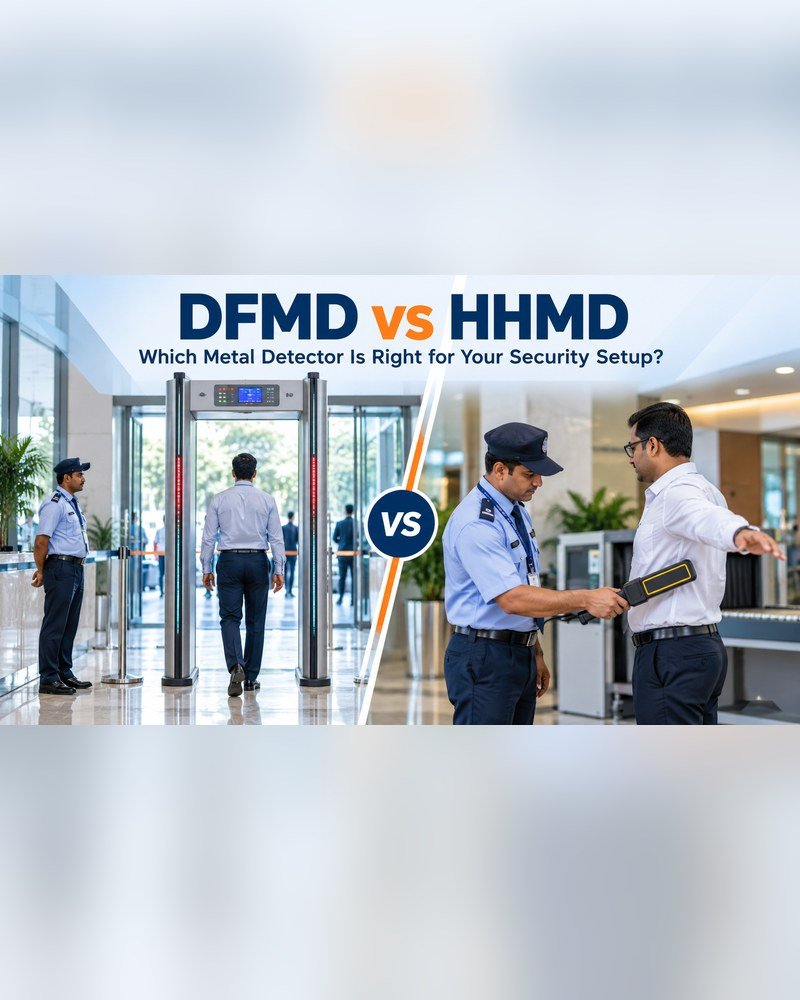
Security screening is an important part of protecting offices, factories, educational institutions, commercial buildings, and public facilities. Choosing the right metal detection equipment can help security teams manage entrance screening more efficiently.
Two commonly used solutions are the Door Frame Metal Detector (DFMD) and the Hand Held Metal Detector (HHMD). Although both are designed to detect metallic objects, they serve different operational purposes.
Understanding the difference between these systems can help organizations select the right equipment for their security requirements.
What Is a DFMD?
A Door Frame Metal Detector (DFMD) is a walk-through metal detection system installed at an entrance or designated screening point. People pass through the detector, which identifies metallic objects within its detection area and activates an alarm when configured detection conditions are met.
Depending on the model, a DFMD may offer multiple detection zones, adjustable sensitivity, audible and visual alarms, and other monitoring features.
DFMD systems are commonly considered for locations with regular pedestrian traffic, including corporate offices, factories, educational institutions, shopping centres, and controlled-access facilities.
What Is an HHMD?
A Hand Held Metal Detector (HHMD) is a portable screening device operated manually by a trained security professional. The operator moves the detector around a person or a specific area to check for metallic objects.
HHMDs are useful for secondary screening, targeted inspections, temporary security arrangements, and locations where a fixed walk-through detector may not be practical.
Their portability allows security personnel to use them at different checkpoints as operational requirements change.
DFMD vs HHMD: Key Differences
Comparison factor | DFMD | HHMD |
Equipment type | Fixed walk-through system | Portable handheld device |
Operation | Person walks through the detection frame | Operator scans manually |
Screening approach | Suitable for screening people at designated entrances | Suitable for individual or targeted checks |
Portability | Usually installed at a fixed location | Easy to carry between locations |
Detection indication | Depends on model; may include zone indicators | Depends on model; typically provides an audible, visual or vibration alert |
Installation | Requires suitable placement and setup | Generally requires minimal setup |
Best suited for | Regular entrance screening | Secondary screening and mobile checks |
Maintenance | May require inspection, calibration and technical servicing | Requires battery, sensor and general condition checks |
The exact capabilities of either device depend on the selected model and manufacturer.
When Should You Choose a DFMD?
A DFMD may be appropriate when an organization needs a designated walk-through screening point and expects a regular flow of people.
Consider a DFMD for:
- Corporate offices with controlled visitor entry
- Factories and industrial facilities
- Schools, colleges and institutional buildings
- Hotels, shopping centres and event venues
- Government and other security-sensitive premises
Before purchasing, evaluate expected pedestrian traffic, available installation space, required detection zones, sensitivity settings, power requirements, and maintenance support.
When Is an HHMD the Better Choice?
An HHMD may be more suitable when security personnel need a portable screening device or must conduct additional checks after an initial screening.
Typical applications include:
- Secondary screening following a DFMD alarm
- Temporary events and changing checkpoints
- Targeted inspections by trained security staff
- Locations with limited space for permanent equipment
An HHMD can complement a fixed screening system, but it does not provide the same walk-through screening arrangement as a DFMD.
Can DFMD and HHMD Be Used Together?
Yes. For some security setups, using both devices can create a practical screening workflow.
A DFMD can serve as the primary walk-through screening point. If an alarm is triggered, trained security personnel can follow the site's screening procedure and use an HHMD for additional inspection when appropriate.
This approach can help staff investigate alarms systematically while maintaining an organized entrance process.
The final arrangement should reflect the site's risk assessment, privacy requirements, applicable procedures, and expected visitor volume.
What Should Buyers Check Before Purchasing?
Before selecting a metal detection system, compare more than the purchase price.
For a DFMD, check:
- Detection zones and sensitivity adjustment
- Alarm indication and control features
- Frame dimensions and installation requirements
- Power supply and operating environment
- Warranty, technical support and spare-parts availability
For an HHMD, check:
- Detection performance and sensitivity controls
- Audible, visual or vibration alerts
- Battery type and expected operating duration
- Weight, handling and ease of use
- Durability, warranty and service availability
Request the manufacturer's specifications and confirm that the proposed equipment meets your operational requirements.
Conclusion
DFMD and HHMD systems serve complementary roles in physical security. A DFMD is designed for walk-through screening at a designated entrance, while an HHMD provides portable, manually operated screening.
For organizations planning entrance security, a DFMD may be suitable as the primary screening system, with an HHMD available for additional checks where required. The right choice depends on the facility, pedestrian traffic, security procedures, and budget.
Explore DFMD Solutions from Houston Systems
Houston Systems provides security and access-control solutions for organizations with different entrance management requirements.
Explore the DFMD product page to learn more about Door Frame Metal Detector solutions and discuss your project requirements.
Contact the team to request product information or a quotation for your facility.


















