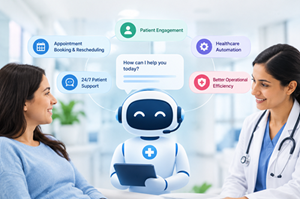
Healthcare is not short of information. The real challenge is getting the right information to the right person at the right time. Patients may need to book appointments, check medical report status, understand insurance requirements, or find out what happens next in their care journey. Meanwhile, healthcare staff often need to navigate multiple systems, coordinate with departments, and respond to repetitive enquiries.
These everyday tasks can create delays for patients and additional pressure on healthcare teams. AI agents in healthcare offer a way to simplify these processes by helping organisations automate routine workflows, improve communication, and deliver more connected patient support.
Unlike traditional chatbots that primarily answer questions, modern AI agents can work toward defined goals, use approved information, coordinate multiple steps, and escalate complex situations to human staff. When implemented responsibly, they can help healthcare organisations improve operational efficiency without compromising the human element of care.
What Are AI Agents in Healthcare?
An AI agent for healthcare is a software system that can interpret a task, access authorised information, perform approved actions, and progress through a workflow with limited manual intervention.
Consider a patient who wants to schedule a consultation, prefers a morning appointment, and needs to confirm insurance eligibility. A basic chatbot might provide the clinic's contact details. An AI agent, when connected to the appropriate systems and permitted workflows, could check availability, present suitable options, help verify eligibility, arrange the appointment, and send confirmation.
This ability to move beyond answering questions toward completing tasks distinguishes agentic AI in healthcare from more traditional conversational systems.
Healthcare organisations can explore these capabilities across patient engagement, appointment management, administrative support, and selected clinical workflows. However, the level of autonomy should always depend on the task's complexity, risk, and need for professional judgment.
Why Healthcare Needs a More Connected Approach to AI
Healthcare involves a combination of repeatable administrative tasks and highly sensitive decisions. Booking an appointment may be straightforward, but an urgent patient concern requires a different response. A billing enquiry may be routine, while an unusual insurance exception may need staff intervention.
This makes healthcare a promising environment for the selective use of artificial intelligence in healthcare. AI can support predictable, rules-based workflows while trained professionals remain responsible for clinical decisions, sensitive conversations, and exceptional cases.
The World Health Organization emphasises the importance of ethics, transparency, accountability, and human rights in the use of AI for health. These principles should guide how healthcare providers evaluate and deploy AI healthcare solutions.
The objective is not to automate every interaction. It is to identify where technology can reduce friction, improve access to information, and help healthcare teams focus on the work that requires their expertise.
Where AI Agents Can Improve the Patient Journey
1. Appointment Booking and Rescheduling
Appointment-related enquiries generate a steady volume of calls, messages, and follow-ups. During busy periods, missed calls and delayed responses can create frustration and prevent patients from completing their bookings.
AI agents can help patients find available appointments, reschedule visits, receive preparation instructions, and get reminders. When a request involves an exception or a more sensitive situation, the interaction can be transferred to the appropriate staff member.
These applications of AI in patient engagement can make appointment management more convenient while reducing repetitive administrative work.
2. Patient Verification and Pre-Visit Support
Before an appointment, patients may need to confirm personal details, check insurance eligibility, understand documentation requirements, or verify appointment information.
With access to authorised systems, an AI agent can assist with defined verification steps and guide patients through the process. Staff can then focus on cases requiring additional checks or intervention.
The purpose is not to eliminate verification requirements. It is to make the process more consistent, reduce avoidable manual effort, and help patients complete necessary steps with fewer delays.
3. Medical Report, Medication, and Status Enquiries
Patients frequently contact healthcare providers to ask whether a medical report is ready, whether a prescription has been processed, or whether an insurance authorisation has been received.
These requests can create unnecessary pressure when staff must manually search across multiple systems to provide an update.
Conversational AI in healthcare can help answer routine status enquiries using approved information sources. It can also direct patients to the appropriate team when a request needs clinical interpretation, additional verification, or personal attention.
The distinction is important: AI can help patients access information and understand the next administrative step, but medical advice and treatment decisions should remain with qualified healthcare professionals.
4. Real-Time Assistance for Healthcare Staff
AI can also support the people delivering patient services. During a live interaction, an AI assistant can help staff retrieve relevant policies, summarise the patient's enquiry, locate approved information, or identify the next administrative step.
This reduces the time employees spend searching across disconnected systems and allows them to concentrate on understanding the patient's needs.
For healthcare contact centres, this type of AI customer service can improve consistency and productivity while preserving the empathy and judgment needed for effective patient communication.
5. Follow-Ups and Care Coordination
A patient's journey often involves several interactions across different departments. After an appointment, a patient may need a reminder, a document, a referral update, or information about a subsequent visit.
AI agents can support approved follow-up workflows, send reminders, and help route outstanding requests to the appropriate team. When systems are connected, relevant context can also be carried forward so patients do not have to repeat the same information unnecessarily.
This creates opportunities for more connected patient experience technology and a smoother journey across administrative touchpoints.
AI Agents Should Support Clinical Judgment, Not Replace It
Healthcare organisations must establish clear boundaries around what AI agents can and cannot do.
Routine scheduling, administrative questions, status updates, and approved workflow steps may be suitable for automation. Diagnosis, treatment recommendations, medication decisions, and urgent or sensitive patient concerns require appropriate clinical oversight and escalation.
Healthcare providers also need to understand how AI systems use information, how their outputs are evaluated, and when human review is necessary. The US Food and Drug Administration provides guidance on AI-enabled medical devices, highlighting the importance of intended use, safety, and performance across the product lifecycle.
A responsible AI healthcare solution should therefore include appropriate access controls, privacy safeguards, traceability, performance monitoring, and clear escalation procedures.
Human oversight is not a limitation to be removed. It is a fundamental part of deploying AI responsibly in healthcare.
The Role of Data Integration in Healthcare Automation
Even a capable AI agent can deliver limited value if the information it needs is fragmented across an electronic health record system, hospital management system, scheduling platform, billing application, or contact centre.
Disconnected systems can force employees to repeat searches, manually transfer information, and verify details across multiple applications. These gaps can slow down both patient support and internal operations.
Healthcare automation should begin by mapping the workflow and identifying where information is lost or delays occur. Organisations can then determine which systems need to be connected, which actions can be automated, and where human approval is required.
A well-designed implementation should include:
- Context: Access to the relevant, authorised information for each task.
- Guardrails: Clear limits on the data and actions available to the AI agent.
- Human handoffs: Appropriate escalation for complex or sensitive cases.
- Traceability: Records that support review of important actions and outputs.
- Measurement: Clear indicators of whether patient and staff experiences are improving.
These foundations help healthcare organisations move from isolated AI experiments toward useful, reliable workflows.
How ResolX Supports AI Agents for Healthcare
ResolX approaches healthcare AI through the combined use of automation, AI-powered interaction management, and human support. Its healthcare solutions address operational challenges across appointment and care coordination, medication and pharmacy enquiries, report status, insurance and documentation support, and patient communication.
Through its AI solutions for healthcare, ResolX aims to help healthcare organisations manage patient interactions more consistently while reducing the burden of repetitive work on their teams.
Its broader ecosystem includes Omvia for connected patient engagement across channels, Frequensee for conversational analytics, PenPal for communication assistance, and Prowise for supporting agents with relevant information during live interactions.
These capabilities can help healthcare teams improve access to information, manage routine enquiries, and maintain context across customer service interactions. Human staff remain essential for clinical judgment, empathy, exceptions, and situations that require individual attention.
The underlying principle is straightforward: successful automation should help patients reach the right outcome, rather than simply increase the number of interactions handled by AI.
How to Measure the Impact of AI in Healthcare
Healthcare organisations should evaluate AI initiatives based on meaningful operational and patient experience outcomes, rather than the number of tasks automated.
Useful measures include:
- Patient effort: Fewer repeated questions, unnecessary transfers, and follow-ups.
- Time to resolution: Less time between a patient's request and the appropriate outcome.
- Appointment performance: Improvements in booking completion, rescheduling, and reminder workflows.
- Staff productivity: Less time spent on repetitive tasks and manual information searches.
- Escalation quality: Sensitive cases reaching the right professional with the necessary context.
- Accuracy and safety: Monitoring incorrect responses, workflow errors, and policy compliance.
Establishing baseline measurements before implementation helps healthcare providers determine whether an AI initiative is delivering genuine value and where further improvements are needed.
The Future of Agentic AI in Healthcare
The future of agentic AI in healthcare is likely to involve more connected workflows rather than simply adding more AI tools.
One agent may assist with appointment management, another may support administrative documentation, and another may help staff retrieve information or coordinate follow-ups. Their value will depend on how effectively these systems exchange authorised information, follow defined rules, and hand tasks to people when necessary.
Healthcare organisations will also need strong governance, secure data access, reliable integrations, and ongoing evaluation as their use of AI expands.
Ultimately, the most successful implementations will not necessarily be those with the greatest number of AI features. They will be those that make healthcare easier to access, help patients understand what happens next, and give healthcare teams more time to focus on people.
Conclusion
AI agents in healthcare have the potential to improve patient experience and operational efficiency by reducing repetitive administrative work, connecting information across workflows, and helping patients receive timely support.
However, lasting value depends on more than automation. Healthcare organisations need reliable data, clear safeguards, meaningful performance measures, and human oversight wherever professional judgment is required.
ResolX supports this approach by bringing AI, automation, and human assistance together to help healthcare organisations manage patient interactions and operational workflows more effectively.
As healthcare continues to adopt agentic AI, the priority should remain clear: use technology to reduce unnecessary friction, support healthcare professionals, and make every patient interaction more connected, responsive, and useful.
Organisations can begin with high-volume, well-defined workflows such as appointment scheduling, routine status enquiries, patient communication, and staff information support. Starting with measurable use cases makes it easier to assess value and manage risk before expanding.